The media has widely reported that Bernard Valcourt has been named ACOA minister. However, that is not so. He has been named a minister of state only; which means he is not a full minister, but a junior minister supporting a more senior minister.
The Order-in-Council designating him a minister of state is now online. It clarifies that he is indeed not the minister of ACOA but "a Minister of State ... to assist ... the Minister for the purposes of the Atlantic Canada Opportunities Agency Act in the carrying out of that Minister’s responsibilities."
So, who is that minister? Well, as I can find no Order-in-Council terminating Keith Ashfield's appointment to that job, it is either still Ashfield or PCO hasn't yet updated it's database with all of the OICs from yesterday.
Inquiring minds want to know.
UPDATE: Confirmed, from watching CPAC's video-on-demand recording of the swearing-in, that Keith Ashfield remains the real ACOA minister, with Valcourt assisting him.
Thursday, May 19, 2011


Thursday, May 05, 2011
What if...
As usual, the lobby groups are crying foul over the election results. These groups favour perpetual minority government by requiring a party to get over 50% of the vote to win a majority government. Under our current system, a party that wins a clear pluarilty can form a majority government. No party has won more than 50% of the vote in Canada since Brian Mulroney in 1984 and then it was just barely.
I was asked on Twitter the other day to take a look at what the election results might have looked like under a different electoral system. I've done this before for provincial elections.
It is impossible to give a perfect picture of what might have been for several reasons. First, is there are nearly an infinite number of possible versions of proportional representation that Canada might choose were it to move in that direction. Second, voters might not cast their ballots in the same way if there were a different electoral system presented to them, especially as they would have a ballot specifically for a party seperate from local candidates in almost all iterations.
There are four main types of proportional representation systems that are worth exploring. For reasons of pure logistics, I can only explore three of them.
Mixed Member Proportional
MMP seems to be the most popular model in Canada, in that it has been chosen by electoral reform groups in three provinces (Ontario, New Brunswick and Prince Edward Island) to be put to a referendum. In Ontario and PEI, voters rejected electoral reform, while in New Brunswick a referendum was never held on the proposal.
In an MMP system, there are two tiers of legislators. The first tier continues to be elected from single member districts as they are today. A second tier are selected for multi-member regions (or the jurisdiction as a whole) based on the popular vote for each party (various types of PR can be used to elect this second tier); the second tier legislators are not selected based on the popular votes however, but are used to proportionalize the overall results to bring legislators from both tiers into as close a possible match to the popular vote. For instance, in the 1993 federal election, most of the second tier seats would have gone to the PCs who won 16% of the vote but less than 1% of the seats. An explainer of the Ontario-version of MMP can be found here.
MMP is used to elect the German federal parliament, the New Zealand federal parliament and the devolved assemblies of Wales, Scotland and Northern Ireland in the UK.
For the purposes of my analysis, I will assume that each province gets 25% more members assigned to a province-wide region. This would increase the size of the House of Commons from a 308 member both to a 388 member body. For comparison purposes in the table I present below, I have scaled these results down to a 308 member House of Commons.
Single Transferable Vote
STV is the other proportional representation system given serious consideration in Canada. It has been put to a referendum unsuccessfully in British Comlumbia on two separate occassions. Interestingly, BC voters actually voted in favour of STV in 2005, but the referendum was only to be successful if it received the support of 60% of voters. In a do-over in 2009, support for STV declined from 58% to 39%.
In an STV system, ridings are fused together to larger multi-member districts. Parties may, and ususally do, run as many candidates as there are seats in each district. Voters cast a preferential ballot, ranking all of the candidates of all parties in order. Voters could rank all of the candidates for their prefered party first, or they could mix and match. Candidates are elected when they reach the quota for the riding, which in most cases is 1/(n+1) where n is the number of seats up for election. For instance, in a 7-member riding, candidates would win when they get 1/8th of the vote. When a candidate is elected, his or her second preferences votes are distributed to the other candidates. If no candidate is elected in a given counting round, the candidate with the fewest votes is eliminated and his or her votes are distrbuted to the next preferences. An explainer on BC-STV can be found here.
Ireland and Malta are the only countries to use STV for their national legislative elections, though Australia and India also use it to choose the upper house (i.e. Senate-type body).
Unfortunately, as this system is so radically different than our current system, I cannot think of a proper way to extrapolate the election results onto this system so it will not be included in my analysis.
Party-list proportional representation
This is the purest form of PR; it is a simple matter of people voting for a party, and that party gets the percentage of seats that it got in votes. There are closed-list and open-list models; in the former the party puts forward its list of candidates and if they get 20 seats, the top 20 people on the list get elected. It is this model that was proposed to elect the regional (second tier) MLAs in New Brunswick under the MMP proposal here. The latter gives voters two ballots, where they vote for their party of choice and also to rank the individual candidates (like in STV). Under this model, if a party won 20 seats, the top 20 candidates as ranked by voters would be elected.
Israel is the most well known country to use this system, and it doesn't really make a lot of sense on a national level for a country as diverse as Canada. It could also be applied at the provincial or sub-provincial level. It also usually includes a threshold (commonly 2 or 5%) to screen out "fringe parties."
I will run a provincial and national list PR results using both 2% and 5% thresholds for my analysis.
Additional Member Method
This system is very similar to the MMP system, except that rather than a fixed number of seats permanently enlarging the parliament, as many extra seats as necessary are added to proportionalize the result of the single member constituencies. In some elections, where the results came out proportional anyway, there would be no need to add extra seats. In extreme elections - think BC in 2001, New Brunswick in 1987, etc, many extra seats would need to be added to proportionalize the results.
I ran an analysis of the potential impacts of AMM if the extra seats were added at a provincial or national basis. As adding the seats at a provincial basis can distort the provinces' relative share of seats in parliament, I doubt this system would work in Canada. Therefore, I'll only show the national model below. As with MMP, I've scaled the results to a 308 member House of Commons for comparison purposes.
***
Additionally, I was asked to examine the possible impact of the "alternate vote." This system, also known as preferntial voting or instant runoff voting, has been used in Australia since 1918 and is the subject of a referendum today in the UK. AV is not a proportional representation system, it is an evolution of our current first-past-the-post system. In AV, people rank the candidates in their single member constituencies rather than simply marking an X for their prefered candidate. Candidates aren't elected until they get 50% + 1 of the vote, ending vote spliting. The UK electoral commission has a video to explain the difference between FPTP and AV.
Using the best data I could find on voters' second choices (which turned out to be this Leger poll), I ran the ridings through until we got majority winners in each riding. There are a number of huge caveats with this - particularly that there are no second perferences for people voting for minor parties and independents, causing all of those votes to become spolied when their first choice dropped out of the balloting. Another big problem is that I couldn't seperate Quebec's second choices from the rest of Canada, meaning second preference choices of and for the BQ are a bit distorted.
However, this should give us a rough picture of how the result would have been with AV and whether or not vote splitting was responsible for the election of a Conservative majority.
***
Anyway, without further ado, here are the results of the various electoral systems according to my analysis.
Seat comparison
Proportionality comparison (share of votes vs. share of seats)
For all of the data, and most of the calculations used, click here. Some of the calculations were done manually so they are entered directly, while most are the result of spreadsheet-driven calculations.
I'm curious to hear your reactions.
I was asked on Twitter the other day to take a look at what the election results might have looked like under a different electoral system. I've done this before for provincial elections.
It is impossible to give a perfect picture of what might have been for several reasons. First, is there are nearly an infinite number of possible versions of proportional representation that Canada might choose were it to move in that direction. Second, voters might not cast their ballots in the same way if there were a different electoral system presented to them, especially as they would have a ballot specifically for a party seperate from local candidates in almost all iterations.
There are four main types of proportional representation systems that are worth exploring. For reasons of pure logistics, I can only explore three of them.
Mixed Member Proportional
MMP seems to be the most popular model in Canada, in that it has been chosen by electoral reform groups in three provinces (Ontario, New Brunswick and Prince Edward Island) to be put to a referendum. In Ontario and PEI, voters rejected electoral reform, while in New Brunswick a referendum was never held on the proposal.
In an MMP system, there are two tiers of legislators. The first tier continues to be elected from single member districts as they are today. A second tier are selected for multi-member regions (or the jurisdiction as a whole) based on the popular vote for each party (various types of PR can be used to elect this second tier); the second tier legislators are not selected based on the popular votes however, but are used to proportionalize the overall results to bring legislators from both tiers into as close a possible match to the popular vote. For instance, in the 1993 federal election, most of the second tier seats would have gone to the PCs who won 16% of the vote but less than 1% of the seats. An explainer of the Ontario-version of MMP can be found here.
MMP is used to elect the German federal parliament, the New Zealand federal parliament and the devolved assemblies of Wales, Scotland and Northern Ireland in the UK.
For the purposes of my analysis, I will assume that each province gets 25% more members assigned to a province-wide region. This would increase the size of the House of Commons from a 308 member both to a 388 member body. For comparison purposes in the table I present below, I have scaled these results down to a 308 member House of Commons.
Single Transferable Vote
STV is the other proportional representation system given serious consideration in Canada. It has been put to a referendum unsuccessfully in British Comlumbia on two separate occassions. Interestingly, BC voters actually voted in favour of STV in 2005, but the referendum was only to be successful if it received the support of 60% of voters. In a do-over in 2009, support for STV declined from 58% to 39%.
In an STV system, ridings are fused together to larger multi-member districts. Parties may, and ususally do, run as many candidates as there are seats in each district. Voters cast a preferential ballot, ranking all of the candidates of all parties in order. Voters could rank all of the candidates for their prefered party first, or they could mix and match. Candidates are elected when they reach the quota for the riding, which in most cases is 1/(n+1) where n is the number of seats up for election. For instance, in a 7-member riding, candidates would win when they get 1/8th of the vote. When a candidate is elected, his or her second preferences votes are distributed to the other candidates. If no candidate is elected in a given counting round, the candidate with the fewest votes is eliminated and his or her votes are distrbuted to the next preferences. An explainer on BC-STV can be found here.
Ireland and Malta are the only countries to use STV for their national legislative elections, though Australia and India also use it to choose the upper house (i.e. Senate-type body).
Unfortunately, as this system is so radically different than our current system, I cannot think of a proper way to extrapolate the election results onto this system so it will not be included in my analysis.
Party-list proportional representation
This is the purest form of PR; it is a simple matter of people voting for a party, and that party gets the percentage of seats that it got in votes. There are closed-list and open-list models; in the former the party puts forward its list of candidates and if they get 20 seats, the top 20 people on the list get elected. It is this model that was proposed to elect the regional (second tier) MLAs in New Brunswick under the MMP proposal here. The latter gives voters two ballots, where they vote for their party of choice and also to rank the individual candidates (like in STV). Under this model, if a party won 20 seats, the top 20 candidates as ranked by voters would be elected.
Israel is the most well known country to use this system, and it doesn't really make a lot of sense on a national level for a country as diverse as Canada. It could also be applied at the provincial or sub-provincial level. It also usually includes a threshold (commonly 2 or 5%) to screen out "fringe parties."
I will run a provincial and national list PR results using both 2% and 5% thresholds for my analysis.
Additional Member Method
This system is very similar to the MMP system, except that rather than a fixed number of seats permanently enlarging the parliament, as many extra seats as necessary are added to proportionalize the result of the single member constituencies. In some elections, where the results came out proportional anyway, there would be no need to add extra seats. In extreme elections - think BC in 2001, New Brunswick in 1987, etc, many extra seats would need to be added to proportionalize the results.
I ran an analysis of the potential impacts of AMM if the extra seats were added at a provincial or national basis. As adding the seats at a provincial basis can distort the provinces' relative share of seats in parliament, I doubt this system would work in Canada. Therefore, I'll only show the national model below. As with MMP, I've scaled the results to a 308 member House of Commons for comparison purposes.
Additionally, I was asked to examine the possible impact of the "alternate vote." This system, also known as preferntial voting or instant runoff voting, has been used in Australia since 1918 and is the subject of a referendum today in the UK. AV is not a proportional representation system, it is an evolution of our current first-past-the-post system. In AV, people rank the candidates in their single member constituencies rather than simply marking an X for their prefered candidate. Candidates aren't elected until they get 50% + 1 of the vote, ending vote spliting. The UK electoral commission has a video to explain the difference between FPTP and AV.
Using the best data I could find on voters' second choices (which turned out to be this Leger poll), I ran the ridings through until we got majority winners in each riding. There are a number of huge caveats with this - particularly that there are no second perferences for people voting for minor parties and independents, causing all of those votes to become spolied when their first choice dropped out of the balloting. Another big problem is that I couldn't seperate Quebec's second choices from the rest of Canada, meaning second preference choices of and for the BQ are a bit distorted.
However, this should give us a rough picture of how the result would have been with AV and whether or not vote splitting was responsible for the election of a Conservative majority.
Anyway, without further ado, here are the results of the various electoral systems according to my analysis.
Seat comparison
| Actual Results | MMP | NPR2 | NPR5 | PPR2 | PPR5 | AMM | AV | |
| Conservatives | 167 | 139 | 123 | 128 | 125 | 127 | 144 | 145 |
| New Democrats | 102 | 101 | 95 | 99 | 95 | 98 | 88 | 123 |
| Liberals | 34 | 50 | 59 | 61 | 59 | 61 | 50 | 38 |
| Bloquistes | 4 | 13 | 19 | 20 | 18 | 18 | 16 | 1 |
| Greens | 1 | 5 | 12 | 0 | 11 | 4 | 10 | 1 |
Proportionality comparison (share of votes vs. share of seats)
| Seat Share | |||||||||
| Vote Share | Actual Results | MMP | NPR2 | NPR5 | PPR2 | PPR5 | AMM | AV | |
| Conservatives | 39.6 | 54.2 | 45.1 | 39.9 | 41.6 | 40.6 | 41.2 | 46.8 | 47.1 |
| New Democrats | 30.7 | 33.1 | 32.8 | 30.8 | 32.1 | 30.8 | 31.8 | 28.6 | 39.9 |
| Liberals | 18.8 | 11.0 | 16.2 | 19.2 | 19.8 | 19.2 | 19.8 | 16.2 | 12.3 |
| Bloquistes | 6.1 | 1.3 | 4.2 | 6.2 | 6.5 | 5.8 | 5.8 | 5.2 | 0.3 |
| Greens | 3.9 | 0.3 | 1.6 | 3.9 | 0 | 3.6 | 1.3 | 3.2 | 0.3 |
For all of the data, and most of the calculations used, click here. Some of the calculations were done manually so they are entered directly, while most are the result of spreadsheet-driven calculations.
I'm curious to hear your reactions.
Tuesday, May 03, 2011
What a night
Last night was the most remarkable Canadian election since at least 1993, possibly since the dawn of television.
Here is my round up of thoughts....
Winners and losers all face challenges
The big winners are obviously the NDP, the Greens and the Conservatives (and I would argue in that order).
But all 5 parties face major challenges going forward.
The Conservatives will no longer be able to use the minority situation as an excuse to their base when justifying not pursing some policies that might not be politically palatable. They will have to walk a difficult balancing act in order to hold their electoral coalition together without risking losing their majority in 2015.
The NDP has a caucus with 60 MPs from Quebec, the vast majority of whom are inexperienced. The party has an opportunity to cement itself as the Canada's new second party, but will have to avoid the pitfalls that brought down Mario Dumont's ADQ after their 2007 breakthrough. Moreover, the NDP will need to be careful to not alienate Quebecers, who gave them their status as the official opposition, with a party that has long been dominated by Ontario operatives. Some of that possible resentment has already started to appear on Twitter.
The Greens get their first MP and Elizabeth May is owed congratulations for succeeding at her risky gambit of going all in on her local campaign. However, the Greens stand to lose half of their vote subsidy (having lost half of their national popular vote). Though, if the Conservatives cancel or phase out the subsidy that may be moot. In any event this cash loss will be offset by May being able to use her Hill office budget to employ the brightest lights of the Green Party, and her platform as an MP to get lots of free media.
Now, on to the Liberals and Bloc. Their challenges are more obvious, and more stark. The Liberals face the risk of following their UK forebears into perpetual third party status. The Bloc has only 4 MPs and limited financial resources. Will either be able to rebound from these low water marks?
What does this all mean for New Brunswick?
The Liberals have been reduced to 1 seat for the first time since 1984. And they placed third in 7 of the 10 ridings. The NDP won a remarkable share of the vote and came close to picking up seats in Moncton and Saint John. Is this a good omen for Dominic Cardy and the provincial NDP? Or is it solely a federal phenomenon? If the latter, is it a one time thing or is the NDP poised to make gains here in 2015 as they look to solidify their status as one of the country's two major parties?
And with Harper's new majority holding only 6 seats in Quebec, will unilingual ministers Keith Ashfield and Rob Moore be pushed aside to make room for needed francophones in the cabinet? Bernard Valcourt and Robert Goguen are likely already making that pitch!
What's next for the NDP?
The NDP seems to have lots of potential growth potential. It's birthplace and former stronghold of Saskatchewan eluded them for the 4th straight election (my prediction quite foolishly thought they could rebound to 10 seats there last night's scenario) and were held to only 2 seats in Manitoba. This is highly unusual territory for the NDP and those areas should be worked hard over the next four years if they wish to expand/secure their position.
Here is my round up of thoughts....
Winners and losers all face challenges
The big winners are obviously the NDP, the Greens and the Conservatives (and I would argue in that order).
But all 5 parties face major challenges going forward.
The Conservatives will no longer be able to use the minority situation as an excuse to their base when justifying not pursing some policies that might not be politically palatable. They will have to walk a difficult balancing act in order to hold their electoral coalition together without risking losing their majority in 2015.
The NDP has a caucus with 60 MPs from Quebec, the vast majority of whom are inexperienced. The party has an opportunity to cement itself as the Canada's new second party, but will have to avoid the pitfalls that brought down Mario Dumont's ADQ after their 2007 breakthrough. Moreover, the NDP will need to be careful to not alienate Quebecers, who gave them their status as the official opposition, with a party that has long been dominated by Ontario operatives. Some of that possible resentment has already started to appear on Twitter.
The Greens get their first MP and Elizabeth May is owed congratulations for succeeding at her risky gambit of going all in on her local campaign. However, the Greens stand to lose half of their vote subsidy (having lost half of their national popular vote). Though, if the Conservatives cancel or phase out the subsidy that may be moot. In any event this cash loss will be offset by May being able to use her Hill office budget to employ the brightest lights of the Green Party, and her platform as an MP to get lots of free media.
Now, on to the Liberals and Bloc. Their challenges are more obvious, and more stark. The Liberals face the risk of following their UK forebears into perpetual third party status. The Bloc has only 4 MPs and limited financial resources. Will either be able to rebound from these low water marks?
What does this all mean for New Brunswick?
The Liberals have been reduced to 1 seat for the first time since 1984. And they placed third in 7 of the 10 ridings. The NDP won a remarkable share of the vote and came close to picking up seats in Moncton and Saint John. Is this a good omen for Dominic Cardy and the provincial NDP? Or is it solely a federal phenomenon? If the latter, is it a one time thing or is the NDP poised to make gains here in 2015 as they look to solidify their status as one of the country's two major parties?
And with Harper's new majority holding only 6 seats in Quebec, will unilingual ministers Keith Ashfield and Rob Moore be pushed aside to make room for needed francophones in the cabinet? Bernard Valcourt and Robert Goguen are likely already making that pitch!
What's next for the NDP?
The NDP seems to have lots of potential growth potential. It's birthplace and former stronghold of Saskatchewan eluded them for the 4th straight election (my prediction quite foolishly thought they could rebound to 10 seats there last night's scenario) and were held to only 2 seats in Manitoba. This is highly unusual territory for the NDP and those areas should be worked hard over the next four years if they wish to expand/secure their position.
Friday, April 29, 2011
Federal election prediction - New Brunswick
If you looked at my prediction from last night, you may have noticed my New Brunswick prediciton - 6 CPC, 2 Lib and 2 NDP. I was expecting some reaction to that but maybe my blog isn't as widely read as I'd like to think!
In any event, I will break that out into three categories: easy holds, close holds and seats changing hands.
Easy Holds
The ridings of Tobique-Mactaquac, Fundy-Royal and New Brunswick Southwest are among the safest Conservative seats east of Alberta. They would only change hands if there was a big anti-Conservative sweep. And there doesn't really seem to be one.
The riding of Beauséjour should be just as strong for the Liberals. Acadie-Bathurst for the NDP is a no brainer.
And Miramichi, though some view it as a close race, will be solidly in the blue column Monday night.
Close Holds
I think that Fredericton will stay with Keith Ashfield for a second term but with a surprisingly strong showing by the NDP. I see the NDP placing a close third or even second. Ashfield will be held to the low 40s in terms of percentage of the popular vote.
Brian Murphy will expand on his narrow win in Moncton-Riverview-Dieppe from 2008, but just a bit.
Changing Hands
Jean-Claude D'Amour's three elections have been somewhat flukey. He won Madawaska-Restigouche in 2004 because francophone New Brunswickers weren't ready to accept Harper's new "Reform-Conservative Party". He barely survived in 2006, despite the fact that his Conservative opponent hadn't been on a ballot in 19 years nor really heard from in that time. D'Amours built some strength back up in 2008 but he'll certainly note be able to fend off the force that is Bernard Valcourt.
And I save my boldest prediction for last. There is only reason that Jack Layton went to Saint John this week that I can fathom; their internal polls showed something that is counterintuitive. Rob Moir's record of building the NDP up from nothing in the uber-conservative stronghold of Fundy-Royal coupled with the NDP's strong showing in Saint John in last fall's provincial election (despite not really paying any attention to the Port City) bode well in theory. Layton's visit suggests that there is emperical evidence (in internal NDP polls) to suggest this seat could flip orange.
In any event, I will break that out into three categories: easy holds, close holds and seats changing hands.
Easy Holds
The ridings of Tobique-Mactaquac, Fundy-Royal and New Brunswick Southwest are among the safest Conservative seats east of Alberta. They would only change hands if there was a big anti-Conservative sweep. And there doesn't really seem to be one.
The riding of Beauséjour should be just as strong for the Liberals. Acadie-Bathurst for the NDP is a no brainer.
And Miramichi, though some view it as a close race, will be solidly in the blue column Monday night.
Close Holds
I think that Fredericton will stay with Keith Ashfield for a second term but with a surprisingly strong showing by the NDP. I see the NDP placing a close third or even second. Ashfield will be held to the low 40s in terms of percentage of the popular vote.
Brian Murphy will expand on his narrow win in Moncton-Riverview-Dieppe from 2008, but just a bit.
Changing Hands
Jean-Claude D'Amour's three elections have been somewhat flukey. He won Madawaska-Restigouche in 2004 because francophone New Brunswickers weren't ready to accept Harper's new "Reform-Conservative Party". He barely survived in 2006, despite the fact that his Conservative opponent hadn't been on a ballot in 19 years nor really heard from in that time. D'Amours built some strength back up in 2008 but he'll certainly note be able to fend off the force that is Bernard Valcourt.
And I save my boldest prediction for last. There is only reason that Jack Layton went to Saint John this week that I can fathom; their internal polls showed something that is counterintuitive. Rob Moir's record of building the NDP up from nothing in the uber-conservative stronghold of Fundy-Royal coupled with the NDP's strong showing in Saint John in last fall's provincial election (despite not really paying any attention to the Port City) bode well in theory. Layton's visit suggests that there is emperical evidence (in internal NDP polls) to suggest this seat could flip orange.
Thursday, April 28, 2011
Federal election prediction
I can never resist; here is my federal election prediction.
Not a lot of science here... I ran my gut instincts on the provincial popular votes through UBC's election forecaster and made a few adjustments (mainly in Quebec) to be more in sync with what I believe can be possible considering get-out-the-vote operations, etc.
Here's what I came up with:
I'm not sure what these results would mean in terms of government. The Conservatives would be very small were they to continue in office and would need the support of either the NDP or the Liberals to pass things through the house; the Bloc would not have enough votes to prop up a government.
The Liberals would be left in quite a pickle. Were they to prop up the Tories they would give the NDP the opportunity to reassert that they're the only alternative to the Conservatives and boost their chances at eliminating the Liberals as the principal centre-left party. Were they to join an NDP-led coalition, or just sign a confidence agreement to put the NDP into office solo, they would be giving the NDP the opportunity to have a record in office and remove for eternity the argument that only the Conservatives and Liberals can form a government.
May we indeed live in interesting times.
For those interested, here is my somewhat wacky province-by-province breakdown.
Not a lot of science here... I ran my gut instincts on the provincial popular votes through UBC's election forecaster and made a few adjustments (mainly in Quebec) to be more in sync with what I believe can be possible considering get-out-the-vote operations, etc.
Here's what I came up with:
| CPC | 121 |
| NDP | 91 |
| LPC | 68 |
| BQ | 27 |
| Ind | 1 |
I'm not sure what these results would mean in terms of government. The Conservatives would be very small were they to continue in office and would need the support of either the NDP or the Liberals to pass things through the house; the Bloc would not have enough votes to prop up a government.
The Liberals would be left in quite a pickle. Were they to prop up the Tories they would give the NDP the opportunity to reassert that they're the only alternative to the Conservatives and boost their chances at eliminating the Liberals as the principal centre-left party. Were they to join an NDP-led coalition, or just sign a confidence agreement to put the NDP into office solo, they would be giving the NDP the opportunity to have a record in office and remove for eternity the argument that only the Conservatives and Liberals can form a government.
May we indeed live in interesting times.
For those interested, here is my somewhat wacky province-by-province breakdown.
Wednesday, April 27, 2011
A cautionary tale for the NDP
Not too far from here, not too long ago, there was an election. The campaign had raged for months between two party leaders who weren't well loved by either their party or the people. An underdog yelled from the treetops that there was a third option, and no one heard. Or at least, they acted as though they didn't.
And then, when the distance to the election was being measured in days instead of weeks, something incredible happened. That third option surged in the polls. At first he was rivaling the liberal option for second. Then he pulled ahead just a little bit. And in the final days he actually started to tie the conservative frontrunner and even lead him.
The final results were 38.3% for the conservative frontrunner to 36.5% for that implausible third option. The liberal trailed distantly at 19.1%.
We're of course talking about the race for governor of Maine. The conservative Republican is now-governor Paul LePage. The third option was independent Eliot Cutler. And the liberal Democrat was Libby Mitchell.
And one might argue that this isn't such a cautionary tale for the NDP; were they to do as well as this it would be an incredible trimuph. But here's the rub: Cutler won the votes on election day. But he placed third in advanced polling before people realized he was a viable option, handing the election to LePage.
Here in Canada, the NDP surge first started being talked about last Thursday, the day before advanced polling began - and the day before the Easter long weekend. Many people cast their ballots on Good Friday. Would the average voter have even heard about the NDP surge at that point? And had they heard it, would they have thought it a rogue poll that only pertained to Quebec anyway? Today, we're seeing more polls putting the NDP firmly in second place nationally and gaining. But how many anti-Harper voters cast ballots for the Liberals this past weekend thinking they were the only viable alternative? With a record 2 million Canadians voting in those polls, how much damage will that have done to the NDP's high hopes?
Here is Eliot Cutler's take:
And then, when the distance to the election was being measured in days instead of weeks, something incredible happened. That third option surged in the polls. At first he was rivaling the liberal option for second. Then he pulled ahead just a little bit. And in the final days he actually started to tie the conservative frontrunner and even lead him.
The final results were 38.3% for the conservative frontrunner to 36.5% for that implausible third option. The liberal trailed distantly at 19.1%.
We're of course talking about the race for governor of Maine. The conservative Republican is now-governor Paul LePage. The third option was independent Eliot Cutler. And the liberal Democrat was Libby Mitchell.
And one might argue that this isn't such a cautionary tale for the NDP; were they to do as well as this it would be an incredible trimuph. But here's the rub: Cutler won the votes on election day. But he placed third in advanced polling before people realized he was a viable option, handing the election to LePage.
Here in Canada, the NDP surge first started being talked about last Thursday, the day before advanced polling began - and the day before the Easter long weekend. Many people cast their ballots on Good Friday. Would the average voter have even heard about the NDP surge at that point? And had they heard it, would they have thought it a rogue poll that only pertained to Quebec anyway? Today, we're seeing more polls putting the NDP firmly in second place nationally and gaining. But how many anti-Harper voters cast ballots for the Liberals this past weekend thinking they were the only viable alternative? With a record 2 million Canadians voting in those polls, how much damage will that have done to the NDP's high hopes?
Here is Eliot Cutler's take:
Marie had read about my plans for reforming health care in Maine and wanted to know more. She quickly told me that she already had voted; because she didn't say that she had voted for me, I was certain that she hadn't.The cautionary tale is this: the NDP may have peaked too late, for 15% of people have already cast their vote.
After we had talked for three or four minutes, she suddenly looked up at me, stricken.
"Oh dear," she blurted out, "I think I made a mistake!"
"Don't fret," I reassured her. "You can make up for it by persuading two of your friends inside to vote for me!"
Marie ran up to me three times during lunch to report her conquests, which ended up numbering six. But despite her efforts I lost the Maine gubernatorial election.
An Independent starting with zero name recognition in a five-person race, I finished a close second, losing 38% to 37% but winning nearly twice the votes cast for the Democrat.
According to our internal polls, I had the support of only 15% of Maine voters when early voting was about to start in mid-September. By mid-October, after Marie already had voted, I was still in the low 20s. In the end, more than 207,000 voters marked their ballots for me, and perhaps several thousand more would have had they not voted early.
Monday, April 25, 2011
Un gouvernment NPD?
Much like the shocking majority victory for the PQ back in the 1976 provincial election, crazy things are happening electorally in Quebec.
Should the current NDP numbers hold, some are predicting that the NDP could win 30 seats... in Quebec alone.
A few years ago, in a post I wrote about the underacheivements of NDP, I noted that since 1979, the NDP had won 74 different ridings in general elections. Since then, they've won a few more. Throw in 30 from Quebec and you could theoretically see over 100 seats for the Dippers.
That sounds crazy, and it probably won't happen, but crazier things have happened. No one saw the NDP winning 19 seats in Nova Scotia in 1998, and no one saw them forming a government in Ontario in 1990. No one saw the BQ winning 54 seats in Quebec in 1993, or the Tories falling to 2 nationally in that same election.
So what does this all mean for New Brunswick? I was surprised to note that Jack Layton made an appearance in Saint John today.
The NDP got only 16% of the vote there in each of the past two elections. And their high water mark was 19% in 2004. However, Rob Moir grew the vote in neighbouring Fundy-Royal from 16 to 21 and finally to 24% and second place in 2008. He is now running in Saint John. Moreover, 2 of the 3 provincial ridings to ever elect NDP members are in the Port City. Does Layton think that his surge in Quebec will spill across the country and could then translate into winning these sorts of ridings that have never before been on their radar?
If so, Fredericton is probably another possibility. The Liberals didn't nominate a candidate until 10 days into the writ and his signs (and other activities) were very slow in going up as a result. The NDP broke 20% here in 2006, and has often done the same in provincial elections in Fredericton-area ridings.
All this seems to suggest the NDP is on the cusp of a major breakthrough. But one must remember that the NDP could just as easily be the victim of what is called "inefficient vote." This is what happened to the PCs in the 1993, 1997 and 2000 elections. The NDP could suffer from this phenomenon especially in Quebec.
If the NDP were to win 25% of the vote in every single riding in the country, they would walk away with somewhere between 0 and a handful of seats. Apply this to Quebec and the same logic holds. They need to raise their national vote to higher levels, or ensure that their vote is concentrated in specific seats that they win.
In 1997 for instance, we saw some great examples of efficient vs. inefficient vote. Working down the scale we see the BQ getting 4.1 seats for every percentage point of the national popular vote, Reform got 3.1, the NDP got 1.9, and the PCs got only 1.1. In fact, though the PCs had nearly twice the popular votes of the NDP, they actually won 1 seat less.
So, an NDP government still seems impossible. But winning 80-100 seats seemed impossible a week ago.
Neither may happen, but it is certainly something that bears watching.
UPDATE: 308dotcom has more on the possibilities of inefficient NDP votes in Quebec.
Should the current NDP numbers hold, some are predicting that the NDP could win 30 seats... in Quebec alone.
A few years ago, in a post I wrote about the underacheivements of NDP, I noted that since 1979, the NDP had won 74 different ridings in general elections. Since then, they've won a few more. Throw in 30 from Quebec and you could theoretically see over 100 seats for the Dippers.
That sounds crazy, and it probably won't happen, but crazier things have happened. No one saw the NDP winning 19 seats in Nova Scotia in 1998, and no one saw them forming a government in Ontario in 1990. No one saw the BQ winning 54 seats in Quebec in 1993, or the Tories falling to 2 nationally in that same election.
So what does this all mean for New Brunswick? I was surprised to note that Jack Layton made an appearance in Saint John today.
The NDP got only 16% of the vote there in each of the past two elections. And their high water mark was 19% in 2004. However, Rob Moir grew the vote in neighbouring Fundy-Royal from 16 to 21 and finally to 24% and second place in 2008. He is now running in Saint John. Moreover, 2 of the 3 provincial ridings to ever elect NDP members are in the Port City. Does Layton think that his surge in Quebec will spill across the country and could then translate into winning these sorts of ridings that have never before been on their radar?
If so, Fredericton is probably another possibility. The Liberals didn't nominate a candidate until 10 days into the writ and his signs (and other activities) were very slow in going up as a result. The NDP broke 20% here in 2006, and has often done the same in provincial elections in Fredericton-area ridings.
All this seems to suggest the NDP is on the cusp of a major breakthrough. But one must remember that the NDP could just as easily be the victim of what is called "inefficient vote." This is what happened to the PCs in the 1993, 1997 and 2000 elections. The NDP could suffer from this phenomenon especially in Quebec.
If the NDP were to win 25% of the vote in every single riding in the country, they would walk away with somewhere between 0 and a handful of seats. Apply this to Quebec and the same logic holds. They need to raise their national vote to higher levels, or ensure that their vote is concentrated in specific seats that they win.
In 1997 for instance, we saw some great examples of efficient vs. inefficient vote. Working down the scale we see the BQ getting 4.1 seats for every percentage point of the national popular vote, Reform got 3.1, the NDP got 1.9, and the PCs got only 1.1. In fact, though the PCs had nearly twice the popular votes of the NDP, they actually won 1 seat less.
So, an NDP government still seems impossible. But winning 80-100 seats seemed impossible a week ago.
Neither may happen, but it is certainly something that bears watching.
UPDATE: 308dotcom has more on the possibilities of inefficient NDP votes in Quebec.
Thursday, April 21, 2011
Ummm... okay
I guess it shows when Paul Zed isn't your chief of staff anymore...

Someone call Elsie quick!
UPDATE:
Alright, it looks like the Liberals have "fixed" this mistake by changing it to "St. John." As much as I found it funny when they erred in calling it "St. John's," that's a common and excusable mistake. But it is something worse to still get it wrong when intentionally "fixing" it. Good work folks.

Someone call Elsie quick!
UPDATE:
Alright, it looks like the Liberals have "fixed" this mistake by changing it to "St. John." As much as I found it funny when they erred in calling it "St. John's," that's a common and excusable mistake. But it is something worse to still get it wrong when intentionally "fixing" it. Good work folks.
Wednesday, March 30, 2011
Keep May out
Back in 2008, I made the case for Elizabeth May to be included in the debate. This election, I hold a different view.
In 2008, the Greens had a good case to make. They were the modern day answer to Reform and the Bloc in 1993; parties that had not won seats in a general election but polled far ahead of other "fringe" parties and had a good chance of winning seats. They were included in the debates and went on to both win more than 50 seats. How much the debates influenced their electoral showing is, well, a matter for debate, but it is obvious that it helped these parties (particularly Reform) get on to more voters' radars.
In 2011, the Greens no longer can make that case. While neither of the scenarios I envisioned for the Greens after being in the debates in 2008 came to pass, the fact is that their thesis was disproven. The whole argument for the Greens to be in the debates was that they were building up impressive amounts of support with little money and public exposure. The debates would undo the bottleneck they faced allowing them to raise funds and earn votes.
It didn't happen. Their vote increased incrementally as it had for the past several elections. They had no electoral breakthrough, and really didn't do any better than they likely would have without the debate.
The more leaders you have in the leaders' debate, the less of a debate it becomes and what you get is a shouting match. I'm all for including up-and-comers to give them the chance to breakthrough. But when they get that chance and fail, let's not crowd the stage with also rans.
In 2008, the Greens had a good case to make. They were the modern day answer to Reform and the Bloc in 1993; parties that had not won seats in a general election but polled far ahead of other "fringe" parties and had a good chance of winning seats. They were included in the debates and went on to both win more than 50 seats. How much the debates influenced their electoral showing is, well, a matter for debate, but it is obvious that it helped these parties (particularly Reform) get on to more voters' radars.
In 2011, the Greens no longer can make that case. While neither of the scenarios I envisioned for the Greens after being in the debates in 2008 came to pass, the fact is that their thesis was disproven. The whole argument for the Greens to be in the debates was that they were building up impressive amounts of support with little money and public exposure. The debates would undo the bottleneck they faced allowing them to raise funds and earn votes.
It didn't happen. Their vote increased incrementally as it had for the past several elections. They had no electoral breakthrough, and really didn't do any better than they likely would have without the debate.
The more leaders you have in the leaders' debate, the less of a debate it becomes and what you get is a shouting match. I'm all for including up-and-comers to give them the chance to breakthrough. But when they get that chance and fail, let's not crowd the stage with also rans.
Wednesday, March 23, 2011
Harper's easy path to majority
So we're looking at a federal election on May 2 or 9. And at first blush, it looks like Stephen Harper has a pretty easy path to a majority government. As Calgary Grit noted, the current polls suggest an 85% chance of a majority government. (Though he also notes that polls at this point are fairly meaningless as the last three parties ejected from office have led in polls when the writ dropped.)
But let's just assume for a moment that things keep chugging along fairly well for Harper and the Conservatives. After all, the growing number of "scandals" haven't seemed to have stuck and their budget was textbook in its use of microtargetting the sorts of people the Conservatives need to pick up as voters.
As it stands today, the Conservatives are only 11 seats short of a majority. And it isn't unreasonable to imagine that they could hold all or most of the seats they already have. Some like to talk about losses in Quebec, but the last election would seem to be a low-water-mark for them in that province considering all of the anger over arts cuts in 2008.
So let's lake a look at the top 20 pickup opportunities for the Conservatives.
Atlantic Canada
There are a number of pick-up opportunities in Atlantic Canada for the Tories. Newfoundland is an obvious target after they were shut out there in 2008 and now that Danny Williams is gone. And after widening their grip on New Brunswick to 6 seats in 2008, there is plenty of opportunity for them to grow here as well.
St. John's East and St. John's South-Mount Pearl
Both of these seats have been traditionally in the blue column. They went against the Tories in 1993 and 2008 but those seem to be historical anomalies. With Danny Williams gone both of these should be easy targets for the Tories - though Jack Harris may be a bit harder to beat than your average opposition member in St. John's.
Avalon
Fabian Manning very nearly got re-elected here even when Danny Williams was running his ABC campaign. Manning is musing about resigning his Senate seat to run again which would suggest this seat is a target.
Moncton-Riverview-Dieppe
Daniel Allain very nearly defeated Brian Murphy in 2008. Murphy was thought by many to be untouchable so with that x-factor wiped away and the growing rumours that none other than Bernard Lord will be the Conservative candidate, things are looking pretty blue in Moncton.
Madawaska-Restigouche
Jean-Claude D'Amours barely won here in 2006 against former Hatfield minister Jean-Pierre Ouellet. While he did better in 2008, it is hard to imagine him being triumphant again if the rumours about a comeback for Bernard Valcourt are true.
Ontario
Kingston and the Islands
This seat, surrounded on all sides by blue, has been held by narrower and narrower margins by Liberal speaker Peter Milliken. With Milliken retiring it seems to be a sure bet to go Tory.
Simcoe—Grey
Helena Guergis' seat will presumably come back to the Tories, but one never knows how the vote might split if she runs as an independent.
Guelph
The Liberals have been holding this seat by smaller and smaller margins thanks to a very strong Green base here - it was there closest seat to a win in 2008 despite Elizabeth May running unopposed by the Liberals in Central Nova. That coupled with a strong NDP prescence would suggest that a Tory win over a three-way vote split on the left is inevitable eventually.
Welland, Sault Ste. Marie, Thunder Bay—Rainy River, and Thunder Bay—Superior North
These northern and/or rural Ontario seats all went to the NDP by relatively small margins in 2008. They are heavily targeted by the Conservatives and they'll win some if not all of these.
Brampton—Springdale, Brampton West, and Ajax—Pickering
These 905 area code seats all went to the Liberals by relatively small margins in 2008. They are heavily targeted by the Conservatives and they'll win some if not all of these.
Western and Northern Canada
Western Arctic
The NDP barely helded this seat in 2008 and the Conservatives have been heavily targeting Northern Canada generally and this seat specifically.
Esquimalt—Juan de Fuca
Keith Martin has managed to just barely hold on to this seat since switching to the Liberals in 2004. With his retirement it seems a no brainer for the Tories to pick it up.
Edmonton—Strathcona
Can the NDP hold a seat in Edmonton for two elections in a row? I don't think it likely.
Burnaby—Douglas
The Conservatives (and the Canadian Alliance before them) have almost won this seat every election going back to 2000. With Bill Siksay's retirement they may have the edge they need.
Vancouver South
This seat was close enough for an automatic recount in 2008, and will likely be closely targeted again.
But let's just assume for a moment that things keep chugging along fairly well for Harper and the Conservatives. After all, the growing number of "scandals" haven't seemed to have stuck and their budget was textbook in its use of microtargetting the sorts of people the Conservatives need to pick up as voters.
As it stands today, the Conservatives are only 11 seats short of a majority. And it isn't unreasonable to imagine that they could hold all or most of the seats they already have. Some like to talk about losses in Quebec, but the last election would seem to be a low-water-mark for them in that province considering all of the anger over arts cuts in 2008.
So let's lake a look at the top 20 pickup opportunities for the Conservatives.
Atlantic Canada
There are a number of pick-up opportunities in Atlantic Canada for the Tories. Newfoundland is an obvious target after they were shut out there in 2008 and now that Danny Williams is gone. And after widening their grip on New Brunswick to 6 seats in 2008, there is plenty of opportunity for them to grow here as well.
St. John's East and St. John's South-Mount Pearl
Both of these seats have been traditionally in the blue column. They went against the Tories in 1993 and 2008 but those seem to be historical anomalies. With Danny Williams gone both of these should be easy targets for the Tories - though Jack Harris may be a bit harder to beat than your average opposition member in St. John's.
Avalon
Fabian Manning very nearly got re-elected here even when Danny Williams was running his ABC campaign. Manning is musing about resigning his Senate seat to run again which would suggest this seat is a target.
Moncton-Riverview-Dieppe
Daniel Allain very nearly defeated Brian Murphy in 2008. Murphy was thought by many to be untouchable so with that x-factor wiped away and the growing rumours that none other than Bernard Lord will be the Conservative candidate, things are looking pretty blue in Moncton.
Madawaska-Restigouche
Jean-Claude D'Amours barely won here in 2006 against former Hatfield minister Jean-Pierre Ouellet. While he did better in 2008, it is hard to imagine him being triumphant again if the rumours about a comeback for Bernard Valcourt are true.
Ontario
Kingston and the Islands
This seat, surrounded on all sides by blue, has been held by narrower and narrower margins by Liberal speaker Peter Milliken. With Milliken retiring it seems to be a sure bet to go Tory.
Simcoe—Grey
Helena Guergis' seat will presumably come back to the Tories, but one never knows how the vote might split if she runs as an independent.
Guelph
The Liberals have been holding this seat by smaller and smaller margins thanks to a very strong Green base here - it was there closest seat to a win in 2008 despite Elizabeth May running unopposed by the Liberals in Central Nova. That coupled with a strong NDP prescence would suggest that a Tory win over a three-way vote split on the left is inevitable eventually.
Welland, Sault Ste. Marie, Thunder Bay—Rainy River, and Thunder Bay—Superior North
These northern and/or rural Ontario seats all went to the NDP by relatively small margins in 2008. They are heavily targeted by the Conservatives and they'll win some if not all of these.
Brampton—Springdale, Brampton West, and Ajax—Pickering
These 905 area code seats all went to the Liberals by relatively small margins in 2008. They are heavily targeted by the Conservatives and they'll win some if not all of these.
Western and Northern Canada
Western Arctic
The NDP barely helded this seat in 2008 and the Conservatives have been heavily targeting Northern Canada generally and this seat specifically.
Esquimalt—Juan de Fuca
Keith Martin has managed to just barely hold on to this seat since switching to the Liberals in 2004. With his retirement it seems a no brainer for the Tories to pick it up.
Edmonton—Strathcona
Can the NDP hold a seat in Edmonton for two elections in a row? I don't think it likely.
Burnaby—Douglas
The Conservatives (and the Canadian Alliance before them) have almost won this seat every election going back to 2000. With Bill Siksay's retirement they may have the edge they need.
Vancouver South
This seat was close enough for an automatic recount in 2008, and will likely be closely targeted again.
Wednesday, March 09, 2011
Sarah Palin's AlaskaArizona
Politico's Ben Smith reports today that were Sarah Palin to run for president, she would base her campaign in the Phoenix suburb of Scottsdale.
The reason:

The reason:
One lesson of Palin's sometimes-difficult time in the spotlight has been that Alaska is an extremely difficult base for national politics. From a distant political culture to a daunting time difference, Palin hasn't been terribly well served by the fact that her state is little-known to reporters in the lower 48, and that email inquiries arrive at 3:00 a.m. needing answers by 5:00 a.m.There is a more specific rational for the Phoenix area: there are only 6 year-round detinations in the Lower 48 from Anchorage:

- Chicago (home base of the Obama campaign)
- Minneaplois (home base of the Pawlenty campaign)
- Salt Lake City (where both Huntsman and Romney dominate)
- Portland and Seattle (which lie in the Pacific time zone, an extra hour from most of the media)
- and Phoenix.
Tuesday, September 28, 2010
Flaws of proportional representation redux
"This electoral system is so distorted!" many NDPers, Greens and other proponents of proportional representation likely screamed as the results solidified the evening of September 27. Fair Vote Canada was one of these groups, and they demanded New Brunswick forthwith implement the New Brunswick Mixed-Member Proportional (NB MMP) system advocated by the Commission on Legislative Democracy.
But if we had NB MMP in place, we might well have heard others screaming the same thing.
In 1947, Winston Churchill said "democracy is the worst form of government, except for all those other forms that have been tried from time to time." You might easily substitute in our specific type of democracy, first-past-the-post.
I re-ran the 2006 election results through the NB MMP model a while back, and explained why I didn't think PR proponents would care much for the result.
Running the 2010 results through NB MMP and comparing it to 2006, raises even more problems.
Here is what the results would have looked like if you apply the 2010 election results through the model using the same assumptions I used in my 2006 analysis.
Here you do actually largely achieve what PR proponents want - a seat share for each party relatively close to their vote share. But it also shows for all the distortions this particular brand of PR eliminates, it creates many of its own.
This is the second election we've run through NB MMP where a party that gets less than 50% of the vote still wins a majority government, something that PR proponents view as the most cardinal sin of first-past-the-post.
Also troubling for PR types is that under NB MMP, the NDP didn't win any seats with 5.1% of the vote in 2006, but the Greens won 3 seats with 4.5% in 2010. Talk about a distortion! And another distortion is that while the NDP polled 130% more votes than the Greens, they would only have gotten 67% more seats.
No electoral system is without flaw. And NB MMP certainly has its fair share.
I think that Chris Baker may have had the most succinct analysis of PR here.
UPDATE:
My earlier analysis ignored the fact that under the NB MMP model, parties that get less than 5% of the province-wide vote are not eligible for seats. Therefore, the Green Party would not have won any seats under NB MMP if they got the same share of the vote as they did last night.
Here is a revised projection of the results under NB MMP:
Under this model, the Greens lose their Central seat to the Liberals and their other 2 seats to the NDP. This to me presents even greater problems. The Greens, while breaking 5% in two regions of the province and nearly hitting 5% province-wide are shut out.
A question has been asked, even though NB MMP is imperfect, is it better than the status quo? I would argue it is not. To move to NB MMP you give up a large degree of local representation and create two classes of MLAs. In exchange, you are supposed to get more parties represented and prevent parties who don't receive a majority of the vote from winning a majority government. This delivers partially on one point and not at all on the other.
But if we had NB MMP in place, we might well have heard others screaming the same thing.
In 1947, Winston Churchill said "democracy is the worst form of government, except for all those other forms that have been tried from time to time." You might easily substitute in our specific type of democracy, first-past-the-post.
I re-ran the 2006 election results through the NB MMP model a while back, and explained why I didn't think PR proponents would care much for the result.
Running the 2010 results through NB MMP and comparing it to 2006, raises even more problems.
Here is what the results would have looked like if you apply the 2010 election results through the model using the same assumptions I used in my 2006 analysis.
| 2010 actual results | Projected NB MMP seats | |||||
| Seats | % vote | Riding | Regional | Total | ||
| PC | 42 | 48.9 | 27 | 2 | 29 | |
| North | 9 | 46.9 | 6 | 1 | 7 | |
| Central | 13 | 53.0 | 8 | 0 | 8 | |
| Southwest | 13 | 51.7 | 8 | 0 | 8 | |
| Southeast | 7 | 44.2 | 5 | 1 | 6 | |
| Lib | 13 | 34.4 | 9 | 10 | 19 | |
| North | 5 | 38.6 | 3 | 2 | 5 | |
| Central | 1 | 29.9 | 1 | 3 | 4 | |
| Southwest | 1 | 29.6 | 1 | 3 | 4 | |
| Southeast | 6 | 39.1 | 4 | 2 | 6 | |
| NDP | 0 | 10.4 | 0 | 5 | 5 | |
| North | 0 | 12.1 | 0 | 2 | 2 | |
| Central | 0 | 7.7 | 0 | 1 | 1 | |
| Southwest | 0 | 11.9 | 0 | 1 | 1 | |
| Southeast | 0 | 9.6 | 0 | 1 | 1 | |
| Green | 0 | 4.5 | 0 | 3 | 3 | |
| North | 0 | 1.6 | 0 | 0 | 0 | |
| Central | 0 | 5.2 | 0 | 1 | 1 | |
| Southwest | 0 | 4.8 | 0 | 1 | 1 | |
| Southeast | 0 | 6.8 | 0 | 1 | 1 | |
Here you do actually largely achieve what PR proponents want - a seat share for each party relatively close to their vote share. But it also shows for all the distortions this particular brand of PR eliminates, it creates many of its own.
This is the second election we've run through NB MMP where a party that gets less than 50% of the vote still wins a majority government, something that PR proponents view as the most cardinal sin of first-past-the-post.
Also troubling for PR types is that under NB MMP, the NDP didn't win any seats with 5.1% of the vote in 2006, but the Greens won 3 seats with 4.5% in 2010. Talk about a distortion! And another distortion is that while the NDP polled 130% more votes than the Greens, they would only have gotten 67% more seats.
No electoral system is without flaw. And NB MMP certainly has its fair share.
I think that Chris Baker may have had the most succinct analysis of PR here.
UPDATE:
My earlier analysis ignored the fact that under the NB MMP model, parties that get less than 5% of the province-wide vote are not eligible for seats. Therefore, the Green Party would not have won any seats under NB MMP if they got the same share of the vote as they did last night.
Here is a revised projection of the results under NB MMP:
| 2010 actual results | Projected NB MMP seats | |||||
| Seats | % vote | Riding | Regional | Total | ||
| PC | 42 | 48.9 | 27 | 2 | 29 | |
| North | 9 | 46.9 | 6 | 1 | 7 | |
| Central | 13 | 53.0 | 8 | 0 | 8 | |
| Southwest | 13 | 51.7 | 8 | 0 | 8 | |
| Southeast | 7 | 44.2 | 5 | 1 | 6 | |
| Lib | 13 | 34.4 | 9 | 11 | 20 | |
| North | 5 | 38.6 | 3 | 2 | 5 | |
| Central | 1 | 29.9 | 1 | 4 | 5 | |
| Southwest | 1 | 29.6 | 1 | 3 | 4 | |
| Southeast | 6 | 39.1 | 4 | 2 | 6 | |
| NDP | 0 | 10.4 | 0 | 7 | 7 | |
| North | 0 | 12.1 | 0 | 2 | 2 | |
| Central | 0 | 7.7 | 0 | 1 | 1 | |
| Southwest | 0 | 11.9 | 0 | 2 | 2 | |
| Southeast | 0 | 9.6 | 0 | 2 | 2 | |
Under this model, the Greens lose their Central seat to the Liberals and their other 2 seats to the NDP. This to me presents even greater problems. The Greens, while breaking 5% in two regions of the province and nearly hitting 5% province-wide are shut out.
A question has been asked, even though NB MMP is imperfect, is it better than the status quo? I would argue it is not. To move to NB MMP you give up a large degree of local representation and create two classes of MLAs. In exchange, you are supposed to get more parties represented and prevent parties who don't receive a majority of the vote from winning a majority government. This delivers partially on one point and not at all on the other.
Monday, September 27, 2010
Results
Well that was quite something. I think that all signs pointed to a Conservative win, and while I thought they would win a modest majority, I did see the potential for 38 seats.
My sincere congratulations to Mr. Alward and the Conservative campaign who exceeded that with 42 seats (pending at least one recount).
The Tories won all but 3 of the 15 ridings to watch, but also won 7 ridings that I had thought to be Liberal victories. Here is a map with the Tory wins that I didn't forsee highlighted. Of these, considering the big sweep, none are a major surprise. I'll single a few out for comment.


My sincere congratulations to Mr. Alward and the Conservative campaign who exceeded that with 42 seats (pending at least one recount).
The Tories won all but 3 of the 15 ridings to watch, but also won 7 ridings that I had thought to be Liberal victories. Here is a map with the Tory wins that I didn't forsee highlighted. Of these, considering the big sweep, none are a major surprise. I'll single a few out for comment.
- Grand Falls-Drummond-Saint-André (+6)
- Campbellton-Restigouche Centre (+20) - I really missed the ball here as this race wasn't even close to close
- Miramichi Bay-Neguac (+5)
- Quispamsis (+16) - this is a bell-weather and I started to get buyers remorse this afternoon when I realized that, but a 16 point margin is quite something, especially when an opinion poll had given Schryer a 9 point victory just a few weeks ago
- Saint John East (+5) - this result was almost the exact same as 1999 - PC winning with less than 40% due to high NDP vote, I didn't expect the NDP to be able to score anywhere near the 24% they got here and the 28% they got in Saint John Harbour
- Saint John Harbour (9 votes) - this is the first ever PC victory in this riding and with a final result of 30.7-30.5-27.6, this was quite a nail-biter all night
Saturday, September 25, 2010
Final prediction
Here is a list of all of the ridings, organized by my level of confidence. I offer a profile for the 15 ridings to watch. I had promised to limit myself to 10 ridings to watch, but I couldn't get myself below 12. I rounded it up to 15 for fun.
I am absolutely, 100% confident of the outcome
 Albert (PC)
Caraquet (Lib)
Carleton (PC)
Hampton-Kings (PC)
Kings East (PC)
New Maryland-Sunbury West (PC)
Nigadoo-Chaleur (Lib)
Oromocto (PC)
Shediac-Cap-Pelé (Lib)
Woodstock (PC)
TOTAL: PC 7, Lib 3.
I am 99% sure of the outcome
 Centre-Péninsule-Saint-Saveur (Lib)
Fundy-River Valley (PC)
Grand Falls-Drummond-St. André (Lib)
Kent (Lib)
Lamèque-Shippagan-Miscou (PC)
Memramcook-Lakeville-Dieppe (Lib)
Saint John Harbour (Lib)
TOTAL: Lib 5, PC 2;
RUNNING TOTAL: PC 9, Lib 8.
I am confident
 Dieppe Centre-Lewisville (Lib)
Edmundston-St. Basile (PC)
Fredericton-Nashwaaksis (PC)
Moncton North (Lib)
Restigouche-la-Vallée (PC)
Riverview (PC)
Rogersville-Kouchibouguac (Lib)
Rothesay (PC)
Saint John East (Lib)
Saint John Portland (PC)
Saint John-Fundy (PC)
Southwest Miramichi (PC)
York (PC)
TOTAL: PC 9, Lib 4;
RUNNING TOTAL: PC 18, Lib 12... these numbers I would say are the minimums for both parties and all of the numbers above I think you can take to the bank... an electorate can be unpredictable so I am less certain below.
In my mind I feel confident, but I am somehow uneasy
 Campbellton-Restigouche Centre (Lib)
Fredericton-Fort Nashwaak (PC)
Grand Lake-Gagetown (PC)
Madawaska-les-Lacs (PC)
Miramichi Bay-Neguac (Lib)
Miramichi-Bay du Vin (Lib)
Moncton East (Lib)
Petitcodiac (PC)
Quispamsis (Lib)
York North (PC)
TOTAL: PC 5, Lib 5;
RUNNING TOTAL: PC 23, Lib 17
Toss ups - "nbpolitico's fifteen ridings to watch"
These 15 ridings will be the ones to decide the election and are the ones to watch on election night.
Bathurst
This riding has never gone Conservative since its creation in 1967. Prior to that it was part of the multi-member Gloucester riding which only went Conservative once. Notwithstanding that long Liberal history, it has been one of the closest seats in the province for the past two elections. This election will be the third. In 2003, 2006 and again in 2010 it will be a race between Liberal Brian Kenny and Conservative Nancy McKay. Will Kenny's position as a minister in the government help him? Will McKay's two consecutive losses hurt her? What will be the effect of the NDP which will probably poll between 10 and 20 per cent? These are not easy questions to answer, so that makes this a riding to watch. Leans Liberal
Charlotte-Campobello
An opinion poll in the riding of Grand Lake-Gagetown showed People's Alliance leader Kris Austin capturing 23% of the vote. It is not hard to imagine PANB candidate John Craig achieving a similar result. The question is, will that vote come from the Conservatives or the Liberals or from both? Or is his support high enough for him to win himself? These are not easy questions to answer, so that makes this a riding to watch. Leans PC
Charlotte-the Isles
This is traditionally a Liberal stronghold. The old riding of Charlotte Centre (which makes up most of this riding) was Sheldon Lee's fiefdom from 1978 until it merged with mainland parts of Charlotte-Fundy to make the new riding of Charlotte in 1995. Lee held Charlotte until he retired in 2003. The riding stayed in Liberal hands in 2003, and again under its current name in 2006 when it absorbed the island of Grand Manan into its boundaries. The Liberals won the seat fairly comfortably in 2006. The Tories, however, enjoy a 19 point lead in southern and central New Brunswick in the most recent poll. Other polls straight back to the beginning of the campaign show them with a double digit lead in those regions. And that lead is likely amplified in rural ridings, especially those with a large number of NB Power employees (Point Lepreau is in this riding). Will the long tradition of voting Liberal save this riding from a Tory surge? Will the NB Power issue hurt the Liberals here as it appears to be in neighbouring Fundy-River Valley? These are not easy questions to answer, so that makes this a riding to watch. Leans Liberal
Dalhousie-Restigouche East
Generally a reliable Liberal seat, it went Conservative in 1999 and part of what is now this riding also went Conservative in 1974. In 2006, Liberal Donald Arseneault won by an astounding 3,500 votes. Since the last election, two of Dalhousie's three major employers have closed and the last will close within a few months. Since this spring, Donald Arseneault has been deputy premier and in that role has served as the Liberal's principal attack dog against the Conservatives. Will Donald Arseneault's senior role in the cabinet help him? Will his role as an attack dog hurt him? Will voters blame the economic collapse of the riding on Arseneault? And are any negatives enough to wipe out a 3,500 vote margin? These are not easy questions to answer, so that makes this a riding to watch. Leans Liberal
Fredericton-Lincoln
This was a new riding in 2006, taking large parts of the relatively new riding of Fredericton-Fort Nashwaak (created in 1995) and New Maryland. It is hard to judge its history. Greg Byrne returned to politics after a 7 year absence by running here in 2006 and winning convincingly. In that election, the NDP leader Allison Brewer also ran here taking over 1,000 votes. Over the past year Byrne has served as both finance minister and government house leader making him the face of the government on a large swath of issues. Will the NDP hold its vote or grow it? If the NDP vote slips will it go to Byrne or Conservative Craig Leonard? Will Byrne's role as face of the government on many difficult files hurt him? These are not easy questions to answer, so that makes this a riding to watch. Leans Liberal
Fredericton-Silverwood
Of the Fredericton ridings, this is probably the safest for the Liberals. It has the weakest Conservative candidate and it is the most urban. The riding has changed a lot over the years and the continued growth of Fredericton has caused it to split several times. It lost almost half of itself to Fredericton-Fort Nashwaak (now Fredericton-Lincoln) in 1995 and another smaller chunk in 2006 to Fredericton-Lincoln. It was the only Fredericton proper seat to vote Conservative in 2003, but thanks to a high NDP vote, the Conservatives won with only 41% of the vote that year. Will the NDP return to its previous tradition of getting in the high teens or low twenties or even higher? If so, does that NDP vote come at the expense of the Liberals or the Conservatives? Will a relatively weak Conservative candidate thwart the Tory tide that is surrounding the riding? These are not easy questions to answer, so that makes this a riding to watch. Leans Liberal
Kent South
This riding has been among the best for the Tories in terms of francophone seats not in Madawaska county. It went blue in 1974 (its first election) and 1982. It was held by outgoing premier Camille Thériault (just barely) in 1999, and then returned to Tory hands in a 2001 by-election where it has remained ever since. But with polls showing the Liberals doing very well in a) southeastern New Brunswick, and b) among francophones, this could be the best chance the Liberals have had in quite sometime to snatch it back. Is it possible for Claude Williams to be beaten even with the above factors on the Liberals' side? Is the Liberal lead in the southeast really as big as the polls suggest? These are not easy questions to answer, so that makes this a riding to watch. Leans PC
Miramichi Centre
This riding has gone Conservative twice before - in 1999 when the Tories swept the Miramichi region and in 1982. In 1991, the riding was a three-way split between the Liberals (who won), the Conservatives and the populist-right wing Confederation of Regions party. The Telegraph-Journal polled this riding and showed a result within the margin of error of PC 46 to Liberal 43. Will the downturn of the Miramichi economy hurt Liberal John Foran? Will his history working for the popular MP Tilly Gordon help Conservative Robert Trevors? These are not easy questions to answer, so that makes this a riding to watch. Leans PC
Moncton Crescent
This riding was created out of the Tory stronghold of Petitcodiac in 1995 and has been has been strong every cycle for Conservative John Betts since he ran in 1999. The strong showing for the Liberals in Greater Moncton shows this seat going handily for the Liberals based on the uniform swing however, and the Liberals are running a stronger candidate than last time around. Does the big Tory drop in Greater Moncton impact the anglophone ridings to Moncton's West or just he francophone ridings to its east? Will the Liberal investments in Atlantic Baptist University translate into votes for the Grits? These are not easy questions to answer, so that makes this a riding to watch. Leans PC
Moncton West
From its creation in 1974 to the Liberal sweep of 1987, this riding was in Conservative hands and in 1978 and 1982 the race wasn't even close. It was recaptured by the Tories in their sweep of 1999. They held the seat in 2003 and 2006, but by margins of less than 500 votes. Since the last election, Conservative Joan MacAlpine-Stiles crossed the floor to the Liberals, but she isn't re-offering. The two principal candidates are both big local names: Liberal Anne-Marie Picone Ford is co-owner of Ford's Apothecary and anyone that has ever listened to the radio in Moncton has heard her voice its ads. Conservative Sue Stultz is better known as "the turkey lady" having run for many years a major turkey drive for needy families. Will MacAlpine-Stiles' party switching hurt or help the Liberals? Will two well known women nullify the effects of the provincial campaign in this riding? And if so, is that good for the Liberals - down in the province-wide polls, or good for the Tories - behind the Liberals in the Moncton region? These are not easy questions to answer, so that makes this a riding to watch. Leans Liberal
Nepisiguit
This has traditionally been a Liberal riding, having only gone for the Conservatives in the sweep of 1999. However, the Liberals won it by only 400 votes in 2006. The NDP are strong here, having received one of their best ever results in 1999 when Gilles Halley got 28% of the vote. The battle in this riding is likely principally between the NDP and the Liberals but the Conservatives could easily sneak up the middle in such a race. Will the NDP's Pierre Cyr be able to meet or exceed Halley's 28%? Will a strong NDP vote come at the expense of the Liberals or the Conservatives? Does Liberal Cheryl Lavoie's last minute addition to cabinet help her or hurt her? These are not easy questions to answer, so that makes this a riding to watch. Leans Liberal
Tantramar
Tantramar has behaved almost like an American congressional district in its history. It re-elects incumbents but when an incumbent retires it is a close race. The NDP won the riding in 1982 by just 450 votes upon the retirement of Conservative Lloyd Falkins. Marilyn Trenholme won big majorities in 1987, 1991 and 1995 but after she retired Conservative Peter Mesheau won by only 39 votes in a 1997 by-election. Mesheau was re-elected by huge margins in 1999 and 2003. Conservative Mike Olscamp broke the trend somewhat when he won his first term by over 1,000 votes. However, I've heard from a number of sources that both the Liberal and NDP campaigns are much stronger this time around. Will history be on Mike Olscamp's side and the incumbency give him a huge boost? Will the riding return to its NDP tradition when it got over 30% of the vote in 1978, 1982, 1987 and 1997, and finished second in 1999? Does the large Liberal lead in southeastern New Brunswick extend into this riding? These are not easy questions to answer, so that makes this a riding to watch. Leans PC
Tracadie-Sheila
The NDP have put on a big push in this riding held by the Conservatives since 1994. Conservative Claude Landry seeks a second term, while the Liberals hope to regain a riding they held from its creation in 1974 until Landry's former boss won it in a 1994 by-election. NDP leader Roger Duguay's decision to run here raised a lot of eyebrows, he had previously run in Caraquet, Centre-Péninsule and Miramichi Bay-Neguac - all of which would be considered better prospects for the NDP. Notwithstanding long odds, Duguay has a number of political professionals working full-time to help win the riding, he has spent almost all of his time there and polls show the NDP riding high in northern and francophone New Brunswick. Will the NDP be able to make a breakthrough here? Will Claude Landry be able to continue to maintain the strong support former Conservative MLA Elvy Robichaud enjoyed here? Will the Liberals be able to sneak up the middle in what is largely a Conservative-NDP battle? These are not easy questions to answer, so that makes this a riding to watch. Leans NDP
Saint John Lancaster
This riding was created out of parts of Saint John West (a Conservative stronghold) and Saint John Harbour (a Liberal stronghold). It went Liberal in 1995, 2003 and 2006, while it went Conservative in 1999. Abel LeBlanc is very popular in the poorer, harbour parts of the riding, while the Conservatives enjoy more support in the middle class residential neighbourhoods of the west side. Will the Conservative surge in southern New Brunswick reach into the city of Saint John? Has Abel LeBlanc's salt-of-the-earth approach outstayed its welcome? These are not easy questions to answer, so that makes this a riding to watch. Leans Liberal
Victoria-Tobique
This riding was traditionally a Conservative stronghold. Then in 1987, the Liberals won every seat in the province. The Tories expected to regain the seat in 1991 but were foiled by a vote-split with the Confederation of Regions Party who took 1,580 votes to the Conservatives' 1,664. In 1995, they tried again and lost by only 7 votes while COR took 600. After that, Liberal Larry Kennedy had become well entrenched and against poor Conservative candidates Kennedy won by more comfortable margins in 1999 and 2003. In 2004, the Conservative government's health plan promised to close both hospitals in the riding, which led Kennedy to win the highest share of the vote of any Liberal in the province. The Conservatives have been doing very well in rural, anglophone New Brunswick according to polling and anecdotal evidence. And David Alward is from a nearby riding with shared media coverage. Will voters have forgotten the hospital issue? Will the riding return to its traditional conservative orientation? And even if it does, will Kennedy's long tenure allow him to hold on anyway? These are not easy questions to answer, so that makes this a riding to watch. Leans Liberal
FINAL PREDICTION: PC 28, Lib 26, NDP 1.

Analysis:
After massive blowouts in elections from 1982 through 1999, this looks like it will be the third consecutive close election, returning New Brunswick to its traditional electoral orientation. That said, the Conservatives certainly have the edge with 50% more safe seats than the Liberals and with 28 seats in the final prediction. With no polling in the past week, it is hard to say whether the trend of the election getting closer has continued, or if the Tory lead has expanded back to 10+ points.
Were the Tories to sweep the "ridings to watch" the result would be PC 38, Liberal 17.
If the Liberals have retaken the lead and were to sweep the "ridings to watch" the result would be Liberal 32, PC 23. That is almost exactly the same as the current standings but it would be a very different legislature with the Liberals losing 7 of the seats they currently hold, including three cabinet ministers.
The NDP is in play in somewhere between 2 and 4 ridings (Tracadie-Sheila, Nepisiguit, Bathurst and Tantramar) according to my analysis. They may also be in play in Saint John Harbour, Saint John East and Fredericton-Silverwood, though my analysis says no.
The People's Alliance is in play in probably two ridings - Grand Lake-Gagetown and Charlotte-Campobello. They should also finish respectably (over 10 per cent) in York North and Southwest Miramichi. Under my analysis they have only one (long) shot at a seat and that is in Charlotte-Campobello.
I do not see the Greens in play anywhere, but I expect to see them get respectable (high single-digit to low double-digit) showings in Fredericton-Nashwaaksis, Fredericton-Fort Nashwaak, Petitcodiac, Tantramar and possibly Charlotte-Campobello.
A divided New Brunswick: What a Liberal win would look like
 While the odds favour a Conservative victory, a Liberal win is not out of the realm of possibility. But the result would make for a very unusual map. The Conservatives will win the majority of the geography of New Brunswick concentrated in the central, western and southern parts of the province.
The Liberal path to victory is one where they use their lead in southeastern New Brunswick to do a near sweep of that region and hold all or most of their seats in northern New Brunswick to counterbalance the sure gains for the Conservatives in the larger anglophone regions in and around Saint John, Fredericton and Miramichi.
The map to your right is not the most likely scenario for a Liberal win, but it is not impossible to imagine this map which shows the most extreme version of what a divided province yielding a Liberal win would look like. In this scenario, the Liberals are held solely to seats on the Northumberland and Chaleur coasts with a few seats in Greater Saint John, Fredericton and Victoria County.
And before I leave, here is some fun with numbers. I've taken a number of somewhat absurd "surge" scenarios for various parties of varying degrees of unlikelihood to get these possible results:
Liberal vote completely collapses:
PC 44, Liberal 11
Liberal vote collapses to minor parties:
PC 37, NDP 7, Lib 6, PANB 4, Ind 1
Tory vote completely collapses:
Liberal 44, PC 11
Tory vote collapses to minor parties:
Lib 39, PC 8, NDP 5, PANB 3
Tory vote collapses to minor parties, but in English New Brunswick it goes only to Greens and PANB:
Lib 37, PC 8, NDP 4, Green 3, PANB 3
NDP surge at expense of both major parties:
PC 23, Lib 22, NDP 10
NDP surge at expense of PCs:
Lib 39, PC 12, NDP 4
NDP surge at expense of Liberals:
PC 38, NDP 11, Lib 6
Green surge at expense of both parties:
PC 27, Lib 23, Green 4, NDP 1
PANB surge at expense of both parties:
PC 25, Lib 24, PANB 4, NDP 1, Ind 1
Assuming that this analysis is correct, then the NDP have made a fairly major strategic error. Had they focused their campaign on Liberal voters (i.e. this is the change you can trust, a rational, progressive alternative to these two conservative parties) as opposed to a focus on disconnected and disillusioned voters from both parties they would be in a position to do much better.
I am absolutely, 100% confident of the outcome
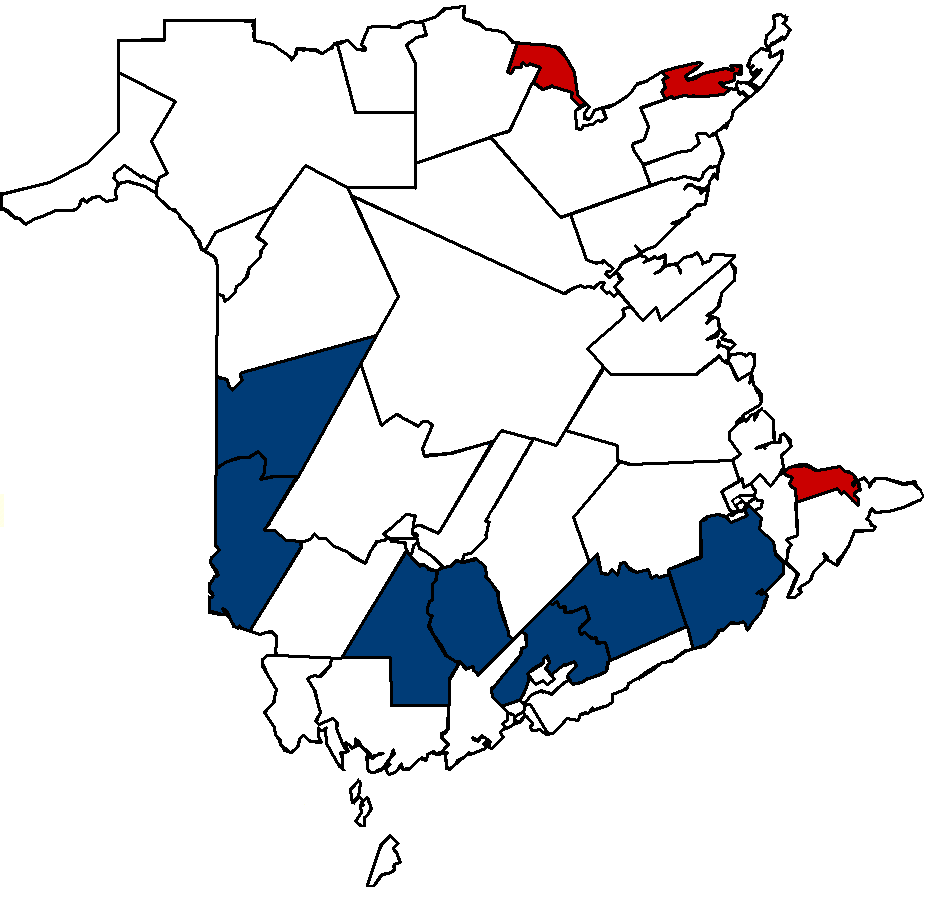 Albert (PC)
Caraquet (Lib)
Carleton (PC)
Hampton-Kings (PC)
Kings East (PC)
New Maryland-Sunbury West (PC)
Nigadoo-Chaleur (Lib)
Oromocto (PC)
Shediac-Cap-Pelé (Lib)
Woodstock (PC)
TOTAL: PC 7, Lib 3.
I am 99% sure of the outcome
 Centre-Péninsule-Saint-Saveur (Lib)
Fundy-River Valley (PC)
Grand Falls-Drummond-St. André (Lib)
Kent (Lib)
Lamèque-Shippagan-Miscou (PC)
Memramcook-Lakeville-Dieppe (Lib)
Saint John Harbour (Lib)
TOTAL: Lib 5, PC 2;
RUNNING TOTAL: PC 9, Lib 8.
I am confident
 Dieppe Centre-Lewisville (Lib)
Edmundston-St. Basile (PC)
Fredericton-Nashwaaksis (PC)
Moncton North (Lib)
Restigouche-la-Vallée (PC)
Riverview (PC)
Rogersville-Kouchibouguac (Lib)
Rothesay (PC)
Saint John East (Lib)
Saint John Portland (PC)
Saint John-Fundy (PC)
Southwest Miramichi (PC)
York (PC)
TOTAL: PC 9, Lib 4;
RUNNING TOTAL: PC 18, Lib 12... these numbers I would say are the minimums for both parties and all of the numbers above I think you can take to the bank... an electorate can be unpredictable so I am less certain below.
In my mind I feel confident, but I am somehow uneasy
 Campbellton-Restigouche Centre (Lib)
Fredericton-Fort Nashwaak (PC)
Grand Lake-Gagetown (PC)
Madawaska-les-Lacs (PC)
Miramichi Bay-Neguac (Lib)
Miramichi-Bay du Vin (Lib)
Moncton East (Lib)
Petitcodiac (PC)
Quispamsis (Lib)
York North (PC)
TOTAL: PC 5, Lib 5;
RUNNING TOTAL: PC 23, Lib 17
Toss ups - "nbpolitico's fifteen ridings to watch"
These 15 ridings will be the ones to decide the election and are the ones to watch on election night.
Bathurst
This riding has never gone Conservative since its creation in 1967. Prior to that it was part of the multi-member Gloucester riding which only went Conservative once. Notwithstanding that long Liberal history, it has been one of the closest seats in the province for the past two elections. This election will be the third. In 2003, 2006 and again in 2010 it will be a race between Liberal Brian Kenny and Conservative Nancy McKay. Will Kenny's position as a minister in the government help him? Will McKay's two consecutive losses hurt her? What will be the effect of the NDP which will probably poll between 10 and 20 per cent? These are not easy questions to answer, so that makes this a riding to watch. Leans Liberal
Charlotte-Campobello
An opinion poll in the riding of Grand Lake-Gagetown showed People's Alliance leader Kris Austin capturing 23% of the vote. It is not hard to imagine PANB candidate John Craig achieving a similar result. The question is, will that vote come from the Conservatives or the Liberals or from both? Or is his support high enough for him to win himself? These are not easy questions to answer, so that makes this a riding to watch. Leans PC
Charlotte-the Isles
This is traditionally a Liberal stronghold. The old riding of Charlotte Centre (which makes up most of this riding) was Sheldon Lee's fiefdom from 1978 until it merged with mainland parts of Charlotte-Fundy to make the new riding of Charlotte in 1995. Lee held Charlotte until he retired in 2003. The riding stayed in Liberal hands in 2003, and again under its current name in 2006 when it absorbed the island of Grand Manan into its boundaries. The Liberals won the seat fairly comfortably in 2006. The Tories, however, enjoy a 19 point lead in southern and central New Brunswick in the most recent poll. Other polls straight back to the beginning of the campaign show them with a double digit lead in those regions. And that lead is likely amplified in rural ridings, especially those with a large number of NB Power employees (Point Lepreau is in this riding). Will the long tradition of voting Liberal save this riding from a Tory surge? Will the NB Power issue hurt the Liberals here as it appears to be in neighbouring Fundy-River Valley? These are not easy questions to answer, so that makes this a riding to watch. Leans Liberal
Dalhousie-Restigouche East
Generally a reliable Liberal seat, it went Conservative in 1999 and part of what is now this riding also went Conservative in 1974. In 2006, Liberal Donald Arseneault won by an astounding 3,500 votes. Since the last election, two of Dalhousie's three major employers have closed and the last will close within a few months. Since this spring, Donald Arseneault has been deputy premier and in that role has served as the Liberal's principal attack dog against the Conservatives. Will Donald Arseneault's senior role in the cabinet help him? Will his role as an attack dog hurt him? Will voters blame the economic collapse of the riding on Arseneault? And are any negatives enough to wipe out a 3,500 vote margin? These are not easy questions to answer, so that makes this a riding to watch. Leans Liberal
Fredericton-Lincoln
This was a new riding in 2006, taking large parts of the relatively new riding of Fredericton-Fort Nashwaak (created in 1995) and New Maryland. It is hard to judge its history. Greg Byrne returned to politics after a 7 year absence by running here in 2006 and winning convincingly. In that election, the NDP leader Allison Brewer also ran here taking over 1,000 votes. Over the past year Byrne has served as both finance minister and government house leader making him the face of the government on a large swath of issues. Will the NDP hold its vote or grow it? If the NDP vote slips will it go to Byrne or Conservative Craig Leonard? Will Byrne's role as face of the government on many difficult files hurt him? These are not easy questions to answer, so that makes this a riding to watch. Leans Liberal
Fredericton-Silverwood
Of the Fredericton ridings, this is probably the safest for the Liberals. It has the weakest Conservative candidate and it is the most urban. The riding has changed a lot over the years and the continued growth of Fredericton has caused it to split several times. It lost almost half of itself to Fredericton-Fort Nashwaak (now Fredericton-Lincoln) in 1995 and another smaller chunk in 2006 to Fredericton-Lincoln. It was the only Fredericton proper seat to vote Conservative in 2003, but thanks to a high NDP vote, the Conservatives won with only 41% of the vote that year. Will the NDP return to its previous tradition of getting in the high teens or low twenties or even higher? If so, does that NDP vote come at the expense of the Liberals or the Conservatives? Will a relatively weak Conservative candidate thwart the Tory tide that is surrounding the riding? These are not easy questions to answer, so that makes this a riding to watch. Leans Liberal
Kent South
This riding has been among the best for the Tories in terms of francophone seats not in Madawaska county. It went blue in 1974 (its first election) and 1982. It was held by outgoing premier Camille Thériault (just barely) in 1999, and then returned to Tory hands in a 2001 by-election where it has remained ever since. But with polls showing the Liberals doing very well in a) southeastern New Brunswick, and b) among francophones, this could be the best chance the Liberals have had in quite sometime to snatch it back. Is it possible for Claude Williams to be beaten even with the above factors on the Liberals' side? Is the Liberal lead in the southeast really as big as the polls suggest? These are not easy questions to answer, so that makes this a riding to watch. Leans PC
Miramichi Centre
This riding has gone Conservative twice before - in 1999 when the Tories swept the Miramichi region and in 1982. In 1991, the riding was a three-way split between the Liberals (who won), the Conservatives and the populist-right wing Confederation of Regions party. The Telegraph-Journal polled this riding and showed a result within the margin of error of PC 46 to Liberal 43. Will the downturn of the Miramichi economy hurt Liberal John Foran? Will his history working for the popular MP Tilly Gordon help Conservative Robert Trevors? These are not easy questions to answer, so that makes this a riding to watch. Leans PC
Moncton Crescent
This riding was created out of the Tory stronghold of Petitcodiac in 1995 and has been has been strong every cycle for Conservative John Betts since he ran in 1999. The strong showing for the Liberals in Greater Moncton shows this seat going handily for the Liberals based on the uniform swing however, and the Liberals are running a stronger candidate than last time around. Does the big Tory drop in Greater Moncton impact the anglophone ridings to Moncton's West or just he francophone ridings to its east? Will the Liberal investments in Atlantic Baptist University translate into votes for the Grits? These are not easy questions to answer, so that makes this a riding to watch. Leans PC
Moncton West
From its creation in 1974 to the Liberal sweep of 1987, this riding was in Conservative hands and in 1978 and 1982 the race wasn't even close. It was recaptured by the Tories in their sweep of 1999. They held the seat in 2003 and 2006, but by margins of less than 500 votes. Since the last election, Conservative Joan MacAlpine-Stiles crossed the floor to the Liberals, but she isn't re-offering. The two principal candidates are both big local names: Liberal Anne-Marie Picone Ford is co-owner of Ford's Apothecary and anyone that has ever listened to the radio in Moncton has heard her voice its ads. Conservative Sue Stultz is better known as "the turkey lady" having run for many years a major turkey drive for needy families. Will MacAlpine-Stiles' party switching hurt or help the Liberals? Will two well known women nullify the effects of the provincial campaign in this riding? And if so, is that good for the Liberals - down in the province-wide polls, or good for the Tories - behind the Liberals in the Moncton region? These are not easy questions to answer, so that makes this a riding to watch. Leans Liberal
Nepisiguit
This has traditionally been a Liberal riding, having only gone for the Conservatives in the sweep of 1999. However, the Liberals won it by only 400 votes in 2006. The NDP are strong here, having received one of their best ever results in 1999 when Gilles Halley got 28% of the vote. The battle in this riding is likely principally between the NDP and the Liberals but the Conservatives could easily sneak up the middle in such a race. Will the NDP's Pierre Cyr be able to meet or exceed Halley's 28%? Will a strong NDP vote come at the expense of the Liberals or the Conservatives? Does Liberal Cheryl Lavoie's last minute addition to cabinet help her or hurt her? These are not easy questions to answer, so that makes this a riding to watch. Leans Liberal
Tantramar
Tantramar has behaved almost like an American congressional district in its history. It re-elects incumbents but when an incumbent retires it is a close race. The NDP won the riding in 1982 by just 450 votes upon the retirement of Conservative Lloyd Falkins. Marilyn Trenholme won big majorities in 1987, 1991 and 1995 but after she retired Conservative Peter Mesheau won by only 39 votes in a 1997 by-election. Mesheau was re-elected by huge margins in 1999 and 2003. Conservative Mike Olscamp broke the trend somewhat when he won his first term by over 1,000 votes. However, I've heard from a number of sources that both the Liberal and NDP campaigns are much stronger this time around. Will history be on Mike Olscamp's side and the incumbency give him a huge boost? Will the riding return to its NDP tradition when it got over 30% of the vote in 1978, 1982, 1987 and 1997, and finished second in 1999? Does the large Liberal lead in southeastern New Brunswick extend into this riding? These are not easy questions to answer, so that makes this a riding to watch. Leans PC
Tracadie-Sheila
The NDP have put on a big push in this riding held by the Conservatives since 1994. Conservative Claude Landry seeks a second term, while the Liberals hope to regain a riding they held from its creation in 1974 until Landry's former boss won it in a 1994 by-election. NDP leader Roger Duguay's decision to run here raised a lot of eyebrows, he had previously run in Caraquet, Centre-Péninsule and Miramichi Bay-Neguac - all of which would be considered better prospects for the NDP. Notwithstanding long odds, Duguay has a number of political professionals working full-time to help win the riding, he has spent almost all of his time there and polls show the NDP riding high in northern and francophone New Brunswick. Will the NDP be able to make a breakthrough here? Will Claude Landry be able to continue to maintain the strong support former Conservative MLA Elvy Robichaud enjoyed here? Will the Liberals be able to sneak up the middle in what is largely a Conservative-NDP battle? These are not easy questions to answer, so that makes this a riding to watch. Leans NDP
Saint John Lancaster
This riding was created out of parts of Saint John West (a Conservative stronghold) and Saint John Harbour (a Liberal stronghold). It went Liberal in 1995, 2003 and 2006, while it went Conservative in 1999. Abel LeBlanc is very popular in the poorer, harbour parts of the riding, while the Conservatives enjoy more support in the middle class residential neighbourhoods of the west side. Will the Conservative surge in southern New Brunswick reach into the city of Saint John? Has Abel LeBlanc's salt-of-the-earth approach outstayed its welcome? These are not easy questions to answer, so that makes this a riding to watch. Leans Liberal
Victoria-Tobique
This riding was traditionally a Conservative stronghold. Then in 1987, the Liberals won every seat in the province. The Tories expected to regain the seat in 1991 but were foiled by a vote-split with the Confederation of Regions Party who took 1,580 votes to the Conservatives' 1,664. In 1995, they tried again and lost by only 7 votes while COR took 600. After that, Liberal Larry Kennedy had become well entrenched and against poor Conservative candidates Kennedy won by more comfortable margins in 1999 and 2003. In 2004, the Conservative government's health plan promised to close both hospitals in the riding, which led Kennedy to win the highest share of the vote of any Liberal in the province. The Conservatives have been doing very well in rural, anglophone New Brunswick according to polling and anecdotal evidence. And David Alward is from a nearby riding with shared media coverage. Will voters have forgotten the hospital issue? Will the riding return to its traditional conservative orientation? And even if it does, will Kennedy's long tenure allow him to hold on anyway? These are not easy questions to answer, so that makes this a riding to watch. Leans Liberal
FINAL PREDICTION: PC 28, Lib 26, NDP 1.
Analysis:
After massive blowouts in elections from 1982 through 1999, this looks like it will be the third consecutive close election, returning New Brunswick to its traditional electoral orientation. That said, the Conservatives certainly have the edge with 50% more safe seats than the Liberals and with 28 seats in the final prediction. With no polling in the past week, it is hard to say whether the trend of the election getting closer has continued, or if the Tory lead has expanded back to 10+ points.
Were the Tories to sweep the "ridings to watch" the result would be PC 38, Liberal 17.
If the Liberals have retaken the lead and were to sweep the "ridings to watch" the result would be Liberal 32, PC 23. That is almost exactly the same as the current standings but it would be a very different legislature with the Liberals losing 7 of the seats they currently hold, including three cabinet ministers.
The NDP is in play in somewhere between 2 and 4 ridings (Tracadie-Sheila, Nepisiguit, Bathurst and Tantramar) according to my analysis. They may also be in play in Saint John Harbour, Saint John East and Fredericton-Silverwood, though my analysis says no.
The People's Alliance is in play in probably two ridings - Grand Lake-Gagetown and Charlotte-Campobello. They should also finish respectably (over 10 per cent) in York North and Southwest Miramichi. Under my analysis they have only one (long) shot at a seat and that is in Charlotte-Campobello.
I do not see the Greens in play anywhere, but I expect to see them get respectable (high single-digit to low double-digit) showings in Fredericton-Nashwaaksis, Fredericton-Fort Nashwaak, Petitcodiac, Tantramar and possibly Charlotte-Campobello.
A divided New Brunswick: What a Liberal win would look like
 While the odds favour a Conservative victory, a Liberal win is not out of the realm of possibility. But the result would make for a very unusual map. The Conservatives will win the majority of the geography of New Brunswick concentrated in the central, western and southern parts of the province.
 The Liberal path to victory is one where they use their lead in southeastern New Brunswick to do a near sweep of that region and hold all or most of their seats in northern New Brunswick to counterbalance the sure gains for the Conservatives in the larger anglophone regions in and around Saint John, Fredericton and Miramichi.
The map to your right is not the most likely scenario for a Liberal win, but it is not impossible to imagine this map which shows the most extreme version of what a divided province yielding a Liberal win would look like. In this scenario, the Liberals are held solely to seats on the Northumberland and Chaleur coasts with a few seats in Greater Saint John, Fredericton and Victoria County.
And before I leave, here is some fun with numbers. I've taken a number of somewhat absurd "surge" scenarios for various parties of varying degrees of unlikelihood to get these possible results:
Liberal vote completely collapses:
PC 44, Liberal 11
Liberal vote collapses to minor parties:
PC 37, NDP 7, Lib 6, PANB 4, Ind 1
Tory vote completely collapses:
Liberal 44, PC 11
Tory vote collapses to minor parties:
Lib 39, PC 8, NDP 5, PANB 3
Tory vote collapses to minor parties, but in English New Brunswick it goes only to Greens and PANB:
Lib 37, PC 8, NDP 4, Green 3, PANB 3
NDP surge at expense of both major parties:
PC 23, Lib 22, NDP 10
NDP surge at expense of PCs:
Lib 39, PC 12, NDP 4
NDP surge at expense of Liberals:
PC 38, NDP 11, Lib 6
Green surge at expense of both parties:
PC 27, Lib 23, Green 4, NDP 1
PANB surge at expense of both parties:
PC 25, Lib 24, PANB 4, NDP 1, Ind 1
Assuming that this analysis is correct, then the NDP have made a fairly major strategic error. Had they focused their campaign on Liberal voters (i.e. this is the change you can trust, a rational, progressive alternative to these two conservative parties) as opposed to a focus on disconnected and disillusioned voters from both parties they would be in a position to do much better.
Friday, September 24, 2010
A "new" poll
Eric at 308dotcom has managed to get CRA to release to him the combined results of their last 3 days in the field (from their surveys for both the TJ and AN/RC/CBC). This includes a regional breakdown.
Here are the numbers as they compare to 2006 and the past two polls with regional breakdowns.
North
South
Moncton
This seems to show the Liberals taking the lead in the north and solidifying their lead in Moncton, with them losing a marginal amount of ground in a stabilizing race in south and central New Brunswick. If you were to assume a uniform swing in the Moncton region, the only PC seats would be Petitcodiac, Riverview and Albert.
In fact, just for fun, here is the result of a uniform swing in each region based on this poll and what the final results would be:

The uniform swing gives us PC 28, Lib 25, NDP 2. Of these, the swing suggests that 17 PC seats (shown in dark blue) are very safe (would be won by more than 1000 votes), 10 Liberal seats (shown in dark red) are very safe and 1 NDP seat is very safe (Miramichi Bay-Neguac). Now the uniform swing has a lot of drawbacks, most notably it is completely blind to local factors. It predicts, for instance, the NDP will get 0 votes in Tracadie-Sheila because they didn't run a candidate there last time. However, it is an interesting experiment nonetheless.
Please note that this is not my prediction, that will follow. However, looking at data in ways like this contributes to my prediction making process.
Here are the numbers as they compare to 2006 and the past two polls with regional breakdowns.
North
| 2006 | CRA/TJ poll (Aug. 26 - Sep. 1) | CRA/AN/RC/CBC poll (Sep. 15-18) | CRA combined sample (Sep. 16-19) | |
| PC | 44 | 44 | 41 | 40 |
| Lib | 50 | 44 | 41 | 44 |
| NDP | 5 | 10 | 10 | 11 |
South
| 2006 | CRA/TJ poll (Aug. 26 - Sep. 1) | CRA/AN/RC/CBC poll (Sep. 15-18) | CRA combined sample (Sep. 16-19) | |
| PC | 47 | 43 | 49 | 49 |
| Lib | 47 | 39 | 31 | 30 |
| NDP | 6 | 11 | 10 | 10 |
Moncton
| 2006 | CRA/TJ poll (Aug. 26 - Sep. 1) | CRA/AN/RC/CBC poll (Sep. 15-18) | CRA combined sample (Sep. 16-19) | |
| PC | 53 | 43 | 35 | 34 |
| Lib | 44 | 44 | 42 | 44 |
| NDP | 3 | 8 | 16 | 15 |
This seems to show the Liberals taking the lead in the north and solidifying their lead in Moncton, with them losing a marginal amount of ground in a stabilizing race in south and central New Brunswick. If you were to assume a uniform swing in the Moncton region, the only PC seats would be Petitcodiac, Riverview and Albert.
In fact, just for fun, here is the result of a uniform swing in each region based on this poll and what the final results would be:
The uniform swing gives us PC 28, Lib 25, NDP 2. Of these, the swing suggests that 17 PC seats (shown in dark blue) are very safe (would be won by more than 1000 votes), 10 Liberal seats (shown in dark red) are very safe and 1 NDP seat is very safe (Miramichi Bay-Neguac). Now the uniform swing has a lot of drawbacks, most notably it is completely blind to local factors. It predicts, for instance, the NDP will get 0 votes in Tracadie-Sheila because they didn't run a candidate there last time. However, it is an interesting experiment nonetheless.
Please note that this is not my prediction, that will follow. However, looking at data in ways like this contributes to my prediction making process.
Wednesday, September 22, 2010
Even more new data
We have the final two CRA/TJ riding polls in the Liberal-held ridings of Miramichi Centre and Fundy-River Valley. At present, both of these ridings are down in the leans PC column, let's see if the data suggests they should be elsewhere.
Miramichi Centre: PC 46, Lib 43, NDP 6, PANB 3, Green 2 (Sept. 17-18)
There are a few other changes that I will make, however:
Moncton East: from toss up to leans Liberal
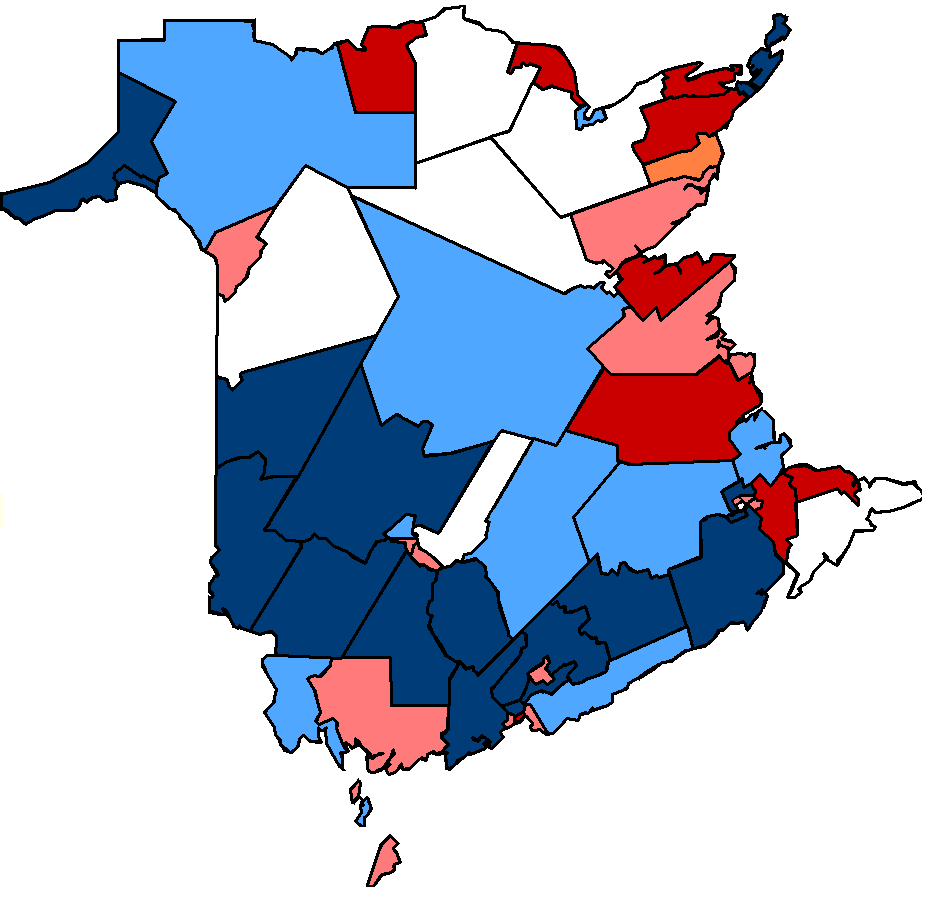 Current projection: the Tories have the edge in a tight race, but the Tories have a base nearly twice as solid as the Liberals
Conservatives: 26 (17 safe + 9 lean)
Liberals: 21 (9 safe + 12 lean)
NDP: 1 (0 safe + 1 lean)
Toss up: 7
Miramichi Centre: PC 46, Lib 43, NDP 6, PANB 3, Green 2 (Sept. 17-18)
Reader feedback I had been receiving suggested that this riding was going to be a Tory blow out. This new data shows that the race is well within the margin of error of +/- 4.6 percentage points. I am moving it to toss up (from leans PC).Fundy-River Valley: PC 53, Lib 36, NDP 5, Green 3, PANB 3 (Sept. 17-18)
With a Tory lead of more than three times the margin of error, this riding belongs in the safe PC column (moving from leans PC).We also have had a new provincial-wide poll by Abacus Data released yesterday. It shows the race as PC 35, Lib 32, NDP 9, Green 5, PANB 2 with undecided sitting at 17% and a margin of error of +/- 3.7 percentage points. Among just decided voters, it is PC 42, Lib 38, NDP 11, Green 6, PANB 2 with a margin of error of +/- 4.0 percentage points. Unfortunately, this poll does not have regional data so it is impossible to tell whether the Tory lead in Fredericton/Saint John and surrounding areas is falling, the Liberal lead in Greater Moncton is widening or if the Liberals are pulling ahead in the north. I will have to rely on your feedback from the ground to help gauge that.
There are a few other changes that I will make, however:
Moncton East: from toss up to leans Liberal
Based on the consistent wide margin for the Liberals in Greater Moncton, this seat should have been moved to leans Liberal some time ago.Moncton West: from leans PC to toss up
Based on the consistent wide margin for the Liberals in Greater Moncton, this seat should move.Nepisiguit: from leans NDP to toss up
Based on overwhelming consensus from reader feedback, I am moving this from to the toss up column.Please keep your comments coming. A final projection on Saturday or Sunday will take the same format as in 2006, I'll eliminate toss ups and hold myself to 10 "leaning" seats which will be the ridings to watch.
Current projection: the Tories have the edge in a tight race, but the Tories have a base nearly twice as solid as the LiberalsConservatives: 26 (17 safe + 9 lean)
Liberals: 21 (9 safe + 12 lean)
NDP: 1 (0 safe + 1 lean)
Toss up: 7
Monday, September 20, 2010
A wealth of new data
There is a whole lot of new data to chew on today. The latest CRA/TJ daily tracking poll, a new CRA poll from Acadie-Nouvelle/Radio-Canada/CBC, two new ridng polls by CRA/TJ, and several other CRA/TJ riding polls since our last update.
We've now seen 8 of the promised 10 riding polls, with Miramichi Centre to come tomorrow and another mystery riding some time after that.
Before I get into the polling results, I will briefly explain why I prefer to use "decided+leaning" voters whenever possible, as opposed to just decided voters. Most pollsters ask two vote intentions questions when they are polling elections. First, they ask who people intend to support. Then they ask those who claim to be undecided if they are leaning toward a particular party. This is done because for a variety of reasons, people may have their mind made up but they don't want to say so. The result is a clearer picture of the true results, and a truer picture of the number of undecideds. For some reason, CRA has always ignored this practice and instead asks only the first question resulting in undecided numbers always in the the 35+ range. This election season they have often relesed the answers to the first question, and the answers to the combined first and second question. When available, I will always use the latter.
An article that explains this phenomenon in detail (as it relates to polling party identification in the United States) can be found in here. Other benefits of asking the second (leaners) question include eliminating phenomena like the UK's "Shy Tory Factor" (when voters have decided to vote for a party that is not fashionable but don't want to admit it) and "Flora Syndrome" (when voters aren't going to vote for a party/candidate that is fashionable but want to say they are anyway).
With that behind us, let's recap the riding polls and see what impact they have on our projections.
Grand Lake-Gagetown: Lib 34, PC 34, PANB 23, Green 2*, NDP 1* (Sept. 8-9)
With respect to the provice-wide polls at our disposal, I have chosen to ignore the CRA/TJ tracking poll. It has a sample of 700 people from Sept. 12-18. The CRA/AN/RC/CBC poll is by the sample pollster (therefore using the same or similar methodology), has a larger sample of 1055, was done over a shorter period and was just as recent. This poll also (unlike the tracker) has regional breakdowns. It breaks into the same three regions (North, South and Moncton and area), as the first day of the CRA/TJ tracking poll when they had a bigger sample and provided regional breakdowns.
The result of today's poll is PC 34%, Lib 29%, NDP 9%, Green 5%, PANB 0% with 17% truly undecided and 6% refusing to say or not intending to vote. With the latter categories factored out the result is PC 44%, Lib 38%, NDP 12%, Green 6%, PANB 0%.
 For analysis let's first take a look, by region, at that the 2006 results, the results of the CRA/TJ poll and the results of the CRA/AN/RC/CBC poll. To compare apples to apples, I will be using the decided and leaning voters (per above) with the undecideds and non-voters factored out. To your right is the table from today's Acadie-Nouvelle showing regional results with the undecideds and non-voters included.
North
South
Moncton
The most interesting result of these numbers is in the Greater Moncton region where the Liberal support has held since the last poll, while the PC support has dropped significantly in favour of the NDP. My instincts suggest that this means that among francophones in this region, the anti-Liberal vote is shifting to the NDP from the PCs. However, as the NDP is not focussing on the region and has little political infrastucture here they won't be able to turn out that vote so some of it will shift back to the PCs and some of those voters will just not go to the polls. In this region, the PCs are down 8 points from their standing just a few weeks ago and 18 points from the last election.
A more significant development (though it is more to be expected so not quite as interesting) is the Liberal collapse in "southern New Brunswick". We have polls from three urban/suburban ridings and one rural riding near Fredericton suggesting that the Liberals are holding their own, so this may be more symptomatic of Liberal support collapsing in ridings that the PCs already hold, but it is impossible for the Liberals to gain seats on a 49-31 spread, and very unlikely that they won't lose some seats as well. In this region, the Liberals are down 8 points from their standing just a few weeks ago and 16 points from the last election.
One might assume that these two regions would largely cancel each other out with gains and losses in each being offset by opposite shifts in the other region. To some extent that is true, but the bad news for the Liberals is that that south region is much larger than the Greater Moncton region.
That brings us to northern New Brunswick. Here, the Liberals are down 9 points from 2006, while the PCs are down 3 from 2006. Both are down 3 from the last poll in late August. This continues to bode relatively well for the NDP who need to be taking votes from both parties in order to win seats up there. However, the NDP may now regret not putting a greater focus on the Moncton region where the francophone vote held by the Conservatives under Lord seems to have shifted to the NDP even without their working that demographic.
I would therefore make the following adjustments.
The North (Victoria, Madawaska, Restigouche, Gloucester and Northumberland counties)
Victoria-Tobique - leans Liberal to toss up
At this stage in the game, with a PC lead of 49-31 in our closest proxy for anglophone New Brunswick, it is hard to put a rural anglophone seat in the Liberal column. If this were any other riding it would be down as leans (or even safe) PC, but because it survived the 1999 PC landslide, I think it should remain a toss up for now.
Restigouche-la-Vallée - toss up to leans PC
The reader feedback was pushing me in this direction anyway but, per the poll above, this obviously belongs on the PC side of the ledger.
Dalhousie-Restigouche East - leans Liberal to toss up
I'm receiving persistent reader feedback that this is more of a race than I suspect in my gut. I will tentatively move it into the "toss up" category until I can learn more.
Bathurst - toss up to leans PC
With the Liberal vote well down from the 2006 election, it is likely that this seat witnessing the third battle in a row between Liberal Brian Kenny and PC Nancy McKay is in play. The last two elections in this traditional Liberal stronghold were nail-biters, we should expect this election to be no different.
(This brings the standings in the "north" - as seemingly defined by CRA - to PC 7, Lib 7, NDP 2, toss up 2.)
The South (Kings, Queens, Saint John, Charlotte, York, Sunbury and Carleton counties)
Quispamsis - toss up to leans Liberal
The poll done by CRA for the TJ in this riding shows Mary Schryer with a relatively comfortable lead of 9 points.
Rothesay - leans PC to safe PC
With an 18 point led in the south, it is impossible to imagine this seat falling out of Tory hands in this election cycle.
Saint John Portland - leans PC to safe PC
With an 18 point led in the south, it is impossible to imagine this seat falling out of Tory hands in this election cycle.
Charlotte-the-Isles - safe Liberal to leans Liberal
The promise by the Conservatives to eliminate tolls on the Grand Manan ferry would seem to suggest that they believe they have a chance in this riding, even though for the most part it has been held for the Liberals since 1978. However, with an 18 point lead for the PCs in the south, it is hard to imagine that there are any truly "safe" Liberal seats here.
York - leans PC to safe PC
With an 18 point led in the south, it is impossible to imagine this seat falling out of Tory hands in this election cycle.
York North - leans PC to safe PC
With an 18 point led in the south, it is impossible to imagine this seat falling out of Tory hands in this election cycle.
(This brings the standings in the "south" - as seemingly defined by CRA - to PC 15, Lib 7, toss up 1.)
Greater Moncton (Kent, Westmorland and Albert counties)
Kent South - safe PC to leans PC
While this is traditionally a relatively reliable seat for the Conservatives and Claude Williams has proved his mettle, unless the Liberals are making major inroads into ridings like Riverview, Albert, Petitcodiac and Moncton Crescent this seat needs to be downgraded to explain the 18 point drop for the Tories versus their 2006 result.
Tantramar - leans PC to toss up
While this is has been a reliable seat for the Conservatives since 1999, unless the Liberals are making major inroads into ridings like Riverview, Albert, Petitcodiac and Moncton Crescent this seat needs to be downgraded to explain the 18 point drop for the Tories versus their 2006 result. It has traditionally (1978-1987 and in the 1998 by-election) been a bit of swing district with with all three parties being in contention.
Dieppe Centre-Lewisville safe Liberal to leans Liberal
The CRA/TJ poll in this riding showed the Liberals leading by 9 points. That keeps it in their column, but a single digit lead in a poll with a relatively high margin of error is not "safe."
Moncton North - leans PC to leans Liberal
The CRA/TJ poll in this riding shows the Liberals ahead by double digits. It belongs in the Liberal column.
(This brings the standings in the "Moncton area" - as seemingly defined by CRA - to PC 6, Lib 6, toss up 2.)
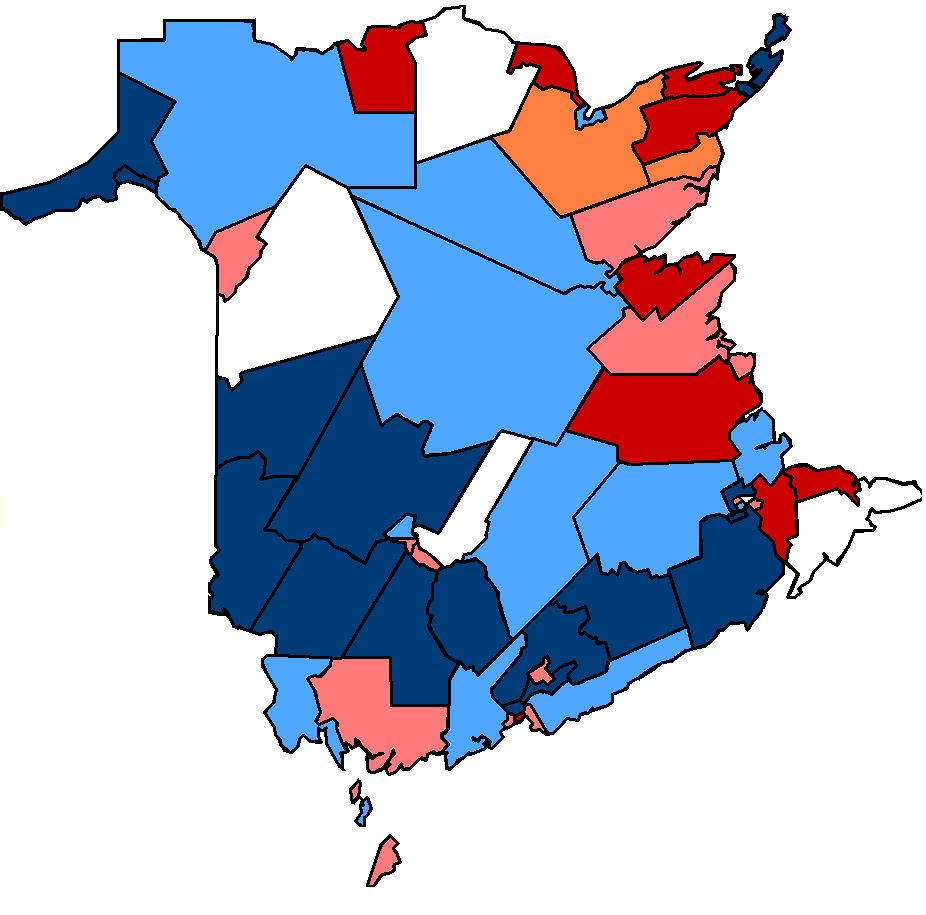 Projection summary - with lots of changes below the surface, our top level numbers are unchanged - PC 28 to Lib 20. However, 3 more seats are in the PCs' safe column and 1 less are in the Liberals'.:
Conservatives: 28 (16 safe + 12 lean)
Liberals: 20 (9 safe + 11 lean)
NDP: 2 (0 safe + 2 lean)
Toss up: 5
We've now seen 8 of the promised 10 riding polls, with Miramichi Centre to come tomorrow and another mystery riding some time after that.
Before I get into the polling results, I will briefly explain why I prefer to use "decided+leaning" voters whenever possible, as opposed to just decided voters. Most pollsters ask two vote intentions questions when they are polling elections. First, they ask who people intend to support. Then they ask those who claim to be undecided if they are leaning toward a particular party. This is done because for a variety of reasons, people may have their mind made up but they don't want to say so. The result is a clearer picture of the true results, and a truer picture of the number of undecideds. For some reason, CRA has always ignored this practice and instead asks only the first question resulting in undecided numbers always in the the 35+ range. This election season they have often relesed the answers to the first question, and the answers to the combined first and second question. When available, I will always use the latter.
An article that explains this phenomenon in detail (as it relates to polling party identification in the United States) can be found in here. Other benefits of asking the second (leaners) question include eliminating phenomena like the UK's "Shy Tory Factor" (when voters have decided to vote for a party that is not fashionable but don't want to admit it) and "Flora Syndrome" (when voters aren't going to vote for a party/candidate that is fashionable but want to say they are anyway).
With that behind us, let's recap the riding polls and see what impact they have on our projections.
Grand Lake-Gagetown: Lib 34, PC 34, PANB 23, Green 2*, NDP 1* (Sept. 8-9)
Current projection: Leans PC. No need to revise this one. While the poll shows a tie, it also showed that when asked for their second choice, the Liberals placed third. Another gut analysis to this one is that it will be hard for PANB to get out their vote, so their number will likely slip on election day (a common phenomenon for minor parties) and my expectation is their vote would split in the PCs' favour.Fredericton-Fort Nashwaak: PC 41, Lib 37, Green 11, NDP 10 (Sept. 9-10)
Current projection: Toss up. No need to revise this one. While the polls shows a PC edge, with the Green and NDP vote high, there is room for it to collapse likely in the Liberals' favour. That would likely even the race up making it too close to call.Caraquet: Lib 57, PC 31, NDP 8, Green 3 (Sept. 10-11)
Current projection: Safe Liberal. No need to revise this one (for obvious reasons).Restigouche-la-Vallée: PC 53, Lib 40, NDP 5, Green 2 (Sept. 11-13)
Current projection: Toss up. While the Restigouche West portion of this riding has a history of strongly favouring incumbents (this was the Tories' best seat in the Liberal sweep of 1987, and one of the Liberals' best in the PC landslide of 1999), this is a significant lead for the PCs and it seems quite obvious that this one should go into at least the leans PC column.Quispamsis: Lib 47, PC 38, NDP 5*, Green 3* (Sept. 13-14)
Current projection: Toss up. This is a fairly signifcant lead for the Liberals, but it is in single digits with a poll with a relatively large margin of error. It moves to leans Liberal but could easily slip back to toss up in the future.Saint John Harbour: Lib 39, PC 24, NDP 24, Green 5*, Ind 2* (Sept. 12-14)
Current projection: Safe Liberal. While a result of 39% should be very disappointing for the Liberals, on a three-way split it isn't bad. And with them 15 points ahead of both of their competitors this remains in the safe column.Moncton North: Lib 45, PC 34, NDP 12, Green 8, PANB 2 (Sept. 15-16)
Current projection: Leans PC. This poll result a surprise to me, having just moved Moncton North into the leans PC column. I will move it to leans Liberal though it is on the cusp of safe Liberal.Dieppe Centre-Lewisville: Lib 45, PC 36, NDP 11, Green 8 (Sept. 15-16)
Current projection: Safe Liberal. As this is in the single digits of a poll with a relatively large margin of error, I will shift it to leans Liberal.* results with an asterisk are for minor parties which include only decided voters as the decided+leaning numbers for smaller parties those ridings was not included in the Telegraph-Journal's reporting.
With respect to the provice-wide polls at our disposal, I have chosen to ignore the CRA/TJ tracking poll. It has a sample of 700 people from Sept. 12-18. The CRA/AN/RC/CBC poll is by the sample pollster (therefore using the same or similar methodology), has a larger sample of 1055, was done over a shorter period and was just as recent. This poll also (unlike the tracker) has regional breakdowns. It breaks into the same three regions (North, South and Moncton and area), as the first day of the CRA/TJ tracking poll when they had a bigger sample and provided regional breakdowns.
The result of today's poll is PC 34%, Lib 29%, NDP 9%, Green 5%, PANB 0% with 17% truly undecided and 6% refusing to say or not intending to vote. With the latter categories factored out the result is PC 44%, Lib 38%, NDP 12%, Green 6%, PANB 0%.
 For analysis let's first take a look, by region, at that the 2006 results, the results of the CRA/TJ poll and the results of the CRA/AN/RC/CBC poll. To compare apples to apples, I will be using the decided and leaning voters (per above) with the undecideds and non-voters factored out. To your right is the table from today's Acadie-Nouvelle showing regional results with the undecideds and non-voters included.
North
| 2006 | CRA/TJ poll (Aug. 26 - Sep. 1) | CRA/AN/RC/CBC poll (Sep. 15-18) | |
| PC | 44 | 44 | 41 |
| Lib | 50 | 44 | 41 |
| NDP | 5 | 10 | 10 |
South
| 2006 | CRA/TJ poll (Aug. 26 - Sep. 1) | CRA/AN/RC/CBC poll (Sep. 15-18) | |
| PC | 47 | 43 | 49 |
| Lib | 47 | 39 | 31 |
| NDP | 6 | 11 | 10 |
Moncton
| 2006 | CRA/TJ poll (Aug. 26 - Sep. 1) | CRA/AN/RC/CBC poll (Sep. 15-18) | |
| PC | 53 | 43 | 35 |
| Lib | 44 | 44 | 42 |
| NDP | 3 | 8 | 16 |
The most interesting result of these numbers is in the Greater Moncton region where the Liberal support has held since the last poll, while the PC support has dropped significantly in favour of the NDP. My instincts suggest that this means that among francophones in this region, the anti-Liberal vote is shifting to the NDP from the PCs. However, as the NDP is not focussing on the region and has little political infrastucture here they won't be able to turn out that vote so some of it will shift back to the PCs and some of those voters will just not go to the polls. In this region, the PCs are down 8 points from their standing just a few weeks ago and 18 points from the last election.
A more significant development (though it is more to be expected so not quite as interesting) is the Liberal collapse in "southern New Brunswick". We have polls from three urban/suburban ridings and one rural riding near Fredericton suggesting that the Liberals are holding their own, so this may be more symptomatic of Liberal support collapsing in ridings that the PCs already hold, but it is impossible for the Liberals to gain seats on a 49-31 spread, and very unlikely that they won't lose some seats as well. In this region, the Liberals are down 8 points from their standing just a few weeks ago and 16 points from the last election.
One might assume that these two regions would largely cancel each other out with gains and losses in each being offset by opposite shifts in the other region. To some extent that is true, but the bad news for the Liberals is that that south region is much larger than the Greater Moncton region.
That brings us to northern New Brunswick. Here, the Liberals are down 9 points from 2006, while the PCs are down 3 from 2006. Both are down 3 from the last poll in late August. This continues to bode relatively well for the NDP who need to be taking votes from both parties in order to win seats up there. However, the NDP may now regret not putting a greater focus on the Moncton region where the francophone vote held by the Conservatives under Lord seems to have shifted to the NDP even without their working that demographic.
I would therefore make the following adjustments.
The North (Victoria, Madawaska, Restigouche, Gloucester and Northumberland counties)
Victoria-Tobique - leans Liberal to toss up
At this stage in the game, with a PC lead of 49-31 in our closest proxy for anglophone New Brunswick, it is hard to put a rural anglophone seat in the Liberal column. If this were any other riding it would be down as leans (or even safe) PC, but because it survived the 1999 PC landslide, I think it should remain a toss up for now.
Restigouche-la-Vallée - toss up to leans PC
The reader feedback was pushing me in this direction anyway but, per the poll above, this obviously belongs on the PC side of the ledger.
Dalhousie-Restigouche East - leans Liberal to toss up
I'm receiving persistent reader feedback that this is more of a race than I suspect in my gut. I will tentatively move it into the "toss up" category until I can learn more.
Bathurst - toss up to leans PC
With the Liberal vote well down from the 2006 election, it is likely that this seat witnessing the third battle in a row between Liberal Brian Kenny and PC Nancy McKay is in play. The last two elections in this traditional Liberal stronghold were nail-biters, we should expect this election to be no different.
(This brings the standings in the "north" - as seemingly defined by CRA - to PC 7, Lib 7, NDP 2, toss up 2.)
The South (Kings, Queens, Saint John, Charlotte, York, Sunbury and Carleton counties)
Quispamsis - toss up to leans Liberal
The poll done by CRA for the TJ in this riding shows Mary Schryer with a relatively comfortable lead of 9 points.
Rothesay - leans PC to safe PC
With an 18 point led in the south, it is impossible to imagine this seat falling out of Tory hands in this election cycle.
Saint John Portland - leans PC to safe PC
With an 18 point led in the south, it is impossible to imagine this seat falling out of Tory hands in this election cycle.
Charlotte-the-Isles - safe Liberal to leans Liberal
The promise by the Conservatives to eliminate tolls on the Grand Manan ferry would seem to suggest that they believe they have a chance in this riding, even though for the most part it has been held for the Liberals since 1978. However, with an 18 point lead for the PCs in the south, it is hard to imagine that there are any truly "safe" Liberal seats here.
York - leans PC to safe PC
With an 18 point led in the south, it is impossible to imagine this seat falling out of Tory hands in this election cycle.
York North - leans PC to safe PC
With an 18 point led in the south, it is impossible to imagine this seat falling out of Tory hands in this election cycle.
(This brings the standings in the "south" - as seemingly defined by CRA - to PC 15, Lib 7, toss up 1.)
Greater Moncton (Kent, Westmorland and Albert counties)
Kent South - safe PC to leans PC
While this is traditionally a relatively reliable seat for the Conservatives and Claude Williams has proved his mettle, unless the Liberals are making major inroads into ridings like Riverview, Albert, Petitcodiac and Moncton Crescent this seat needs to be downgraded to explain the 18 point drop for the Tories versus their 2006 result.
Tantramar - leans PC to toss up
While this is has been a reliable seat for the Conservatives since 1999, unless the Liberals are making major inroads into ridings like Riverview, Albert, Petitcodiac and Moncton Crescent this seat needs to be downgraded to explain the 18 point drop for the Tories versus their 2006 result. It has traditionally (1978-1987 and in the 1998 by-election) been a bit of swing district with with all three parties being in contention.
Dieppe Centre-Lewisville safe Liberal to leans Liberal
The CRA/TJ poll in this riding showed the Liberals leading by 9 points. That keeps it in their column, but a single digit lead in a poll with a relatively high margin of error is not "safe."
Moncton North - leans PC to leans Liberal
The CRA/TJ poll in this riding shows the Liberals ahead by double digits. It belongs in the Liberal column.
(This brings the standings in the "Moncton area" - as seemingly defined by CRA - to PC 6, Lib 6, toss up 2.)
Projection summary - with lots of changes below the surface, our top level numbers are unchanged - PC 28 to Lib 20. However, 3 more seats are in the PCs' safe column and 1 less are in the Liberals'.:Conservatives: 28 (16 safe + 12 lean)
Liberals: 20 (9 safe + 11 lean)
NDP: 2 (0 safe + 2 lean)
Toss up: 5
Subscribe to:
Posts (Atom)

 Posts
Posts

