Tuesday, June 29, 2010

Wither the People's Alliance?

This is the third post in a three-post series on the prospects for New Brunswick's three registered third parties for this fall's provincial election.

The People's Alliance is running as a radically populist party. They will not whip their elected members in any way to support a central party platform, but they are instead a loose alliance of individuals who want to put their constituents before party.

This sounds like a good idea on paper, but it has not proved to work very well in practice both at the federal level and here in New Brunswick.

The Reform Party of Canada ran on a similar platform but it did not take them long to move to a more traditional approach when in parliament. The same happened to the Confederation of Regions here in New Brunswick. In Reform's case, they managed to adapt and thrive (though their populist views eventually vanished when merging to form today's Conservative Party). On the other hand, COR imploded after one term of having elected members.

While this model does not seem to work very well after elections, it does seem to be a good platform on which to run for election. Dissatisfaction with politics as usual (which we are certainly seeing in New Brunswick today) got Reform over 50 seats in 1993 and COR official opposition status in 1991.

While COR is best remembered for being opposed to official bilingualism, this was just one manifestation of a broader view of libertarian/populism. i.e. keep the state out of the people's business and give the people more power over the state.

One presumes that the People's Alliance will do best in ridings where COR did well.

COR won all of almost all of its seats in Greater Fredericton, with two others in anglophone parts of Greater Moncton. It also did relatively well throughout rural southern New Brunswick.

Riding boundaries have changed quite a bit since 1991 (in 1995 and again in 2006) but the following 11 ridings were all or largely represented by COR in 1991:

Albert
Fredericton-Fort Nashwaak
Fredericton-Lincoln*
Fredericton-Nashwaaksis
Grand Lake-Gagetown*
Miramichi Southwest
New Maryland-Sunbury West
Oromocto
Riverview
York
York North
* The old riding of Sunbury makes up significant parts of these two ridings and was represented by COR. The ridings of Queens North (which makes up the rest of Grand Lake-Gagetown) and Frederiton South (which makes up the rest of Fredericton-Lincoln) were won by the Liberals in 1991.


I've colourcoded the ridings based on which party currently represents them. As you can see, both the Liberals and Conservatives are equally at risk.

The highest profile candidates so far are both former Conservative nomination contestants. One is party leader Kris Austin, running in Grand Lake-Gagetown and St. Andrews mayor John Craig in Charlotte-Campobello.

The People's Alliance's hopes rest largely with circumstances outside of their control. Because their ethos is to be against the system, the "system" needs to do something that will spur the disenfranchised to be against the main parties and therefore vote for this party.

Every day that passes since the NB Power debate, the less likely it is for this party to be able to ride the tide of that rage. Moreover, if their voters are most likely to be people that would otherwise vote Conservative, will they actually be able to get votes in an election where the Conservatives have a chance to win? In 1991 the PCs were in shambles and in 1993 they were crushed.

In those elections, voters could choose between a moderate party that was sure to lose and a radical party that was sure to lose. It is very easy to stay pure in those circumstances.

If people who generally prefer less government and small c conservatism have the choice between a more moderate Conservative Party that could win and a populist party that can't, I suspect they are more likely to choose the former.

So barring something dramatic happening between now and September 27, I expect that that People's Alliance will do well enough to scare the mainstream parties in a few ridings, but not likely pick up a seat. I'll set the odds at 20-80.

Tuesday, June 22, 2010

Wither the Greens?

The Green Party is very new in New Brunswick. They have not contested a provincial election before.

They have some credibility in that their leader is disaffected Liberal Jack MacDougall who is well known in political circles for being an excellent campaign organizer.

MacDougall served as organizer for the federal Greens in the 2008 election which saw their share of the vote in New Brunswick climb from to 6.2% from 2.4% in 2006. How much of this has to do with MacDougall is impossible to tell but that 4.2 point increase compares favourably to the national climb of 2.3.

Opinion polls do not have the Greens coming in that high, instead ranging between 2 and 3% (of all voters) in a poll with a margin of error of +/- 3.4.

However, while third parties traditionally underperform their polling numbers because of weak organization, it could be said that the Greens may overperform their polling numbers because of strong organization. We'll have to see.

If the Greens did manage to replicate that 6.2% of the vote, they would still not be likely to win any seats. In fact, COR got 7.1% of the vote in 1995 and even with concentrated support and 6 incumbent MLAs on the ballot they couldn't get a seat.

When MacDougall sought the leadership of the Liberal Party in 2002, he won only 8% of delegates. However, he ran very strong in Saint John where he was active in business and community causes in the 1980s. He actually won a plurality of delegates in several Saint John ridings.

Had MacDougall run in a Saint John area riding, say Saint John-Fundy where long-time MacDougall ally Stuart Jamieson is stepping down, he may have had a shot. As it stands, I suspect he will place third (at best) in his chosen riding of Fredericton-Nashwaaksis.

The prospects for the Greens winning a seat are grim. However, if MacDougall gets into the leaders' debate... you never know. There a great many undecided voters and a great many disgruntled voters in this very unpredictable cycle. One never knows what might happen if an unknown leader of an unknown party were to catch on in a debate.

That said, I would give the chances of the Greens winning a seat 5-95.

Monday, June 21, 2010

Whither the NDP?

The NDP nearly had a breakthrough in francophone New Brunswick in the 1999 election. The double momentum of Yvon Godin's 1997 federal election victory (and to a lesser extent Angela Vautour's in Beauséjour-Petitcodiac), and the decline of the Liberal Party in that election created a tremendous opportunity for them.

Will that opportunity be replicated in 2010 by the party's first Francophone leader running in a riding on the peninsula combined with a Liberal government that, like in 1999, is facing some serious trouble?

Here are the ridings in which the NDP did well in 1999 that fall in or near the boundaries of those two federal ridings:

Nepisiguit 28%
Tantramar 19%
Rogersville-Kouchibouguac 18%
Nigadoo-Chaleur 16%
Centre-Péninsule 14%
Moncton North 14%
Kent South 12%
Riverview 12%
Miramichi Centre 11%

Add to that list two more ridings: Tracadie-Sheila (where party leader Duguay is running) and Miramichi Bay-Neguac (where Duguay ran and got got 26% in 2006).

These are the ridings that the NDP has its best shot of winning. Particularly the Francophone ridings in the northeast and possibly also Moncton North, a traditionally Liberal riding with a strong PC campaign and no Liberal incumbent.

The NDP seems to be going all in on electing their leader, which is probably a fair strategy. The PCs have made two major announcements in Tracadie-Sheila, leading one to believe they are nervous. Equally good hopes could be Nepisiguit, a heavily unionized riding and home base of Yvon Godin, and Rogersville-Kouchibouguac and Moncton North which are open seats. The NDP would be wise to focus on these four.

A weakened Liberal Party and a PC Party with a leader that lacks appeal in Francophone New Brunswick up against a Francophone NDP leader from the peninsula is an ideal scenario for the NDP.

I would give them 50-50 or slightly better odds at the NDP picking up at least one seat. That said, I gave them a seat in my 2006 prediction so I may want to water my wine a bit on those odds.

Certainly something to watch. I'll follow this post up with a post on the prospects for the Greens and the People's Alliance.

Monday, June 07, 2010

Where we stand

The most recent CRA poll is out and it shows a real horse race.

The way CRA presents its polls is a bit confusing. They give you the margin of error of their whole sample, but then take the undecideds out of the sample when they present their numbers.

Let's break it out in a bit more accurate a way.
Full sample of 807 with a +/- MOE of 3.4 points.

Undecided 36
PC 27
Lib 24
NDP 10
Green 3
Other 1
Or we can look at the numbers as they presented them with a more accureate margin of error.
A partial sample of 64% of 807 (516) yields a MOE of +/- 4.3 points

PC 42
Lib 37
NDP 16
Green 5
Other 1
Looking at it either way, the PCs are just inside or outside of the margin of error (the difference likely due to a combination of rounding error and available number of significant digits).

Therefore it is fair to say with some confidence that the PCs appear to be in the lead. But whether you say that are not, it can be said with all confidence that it is pretty close at the moment.

And in any event, the undecideds are a third larger than the largest party!

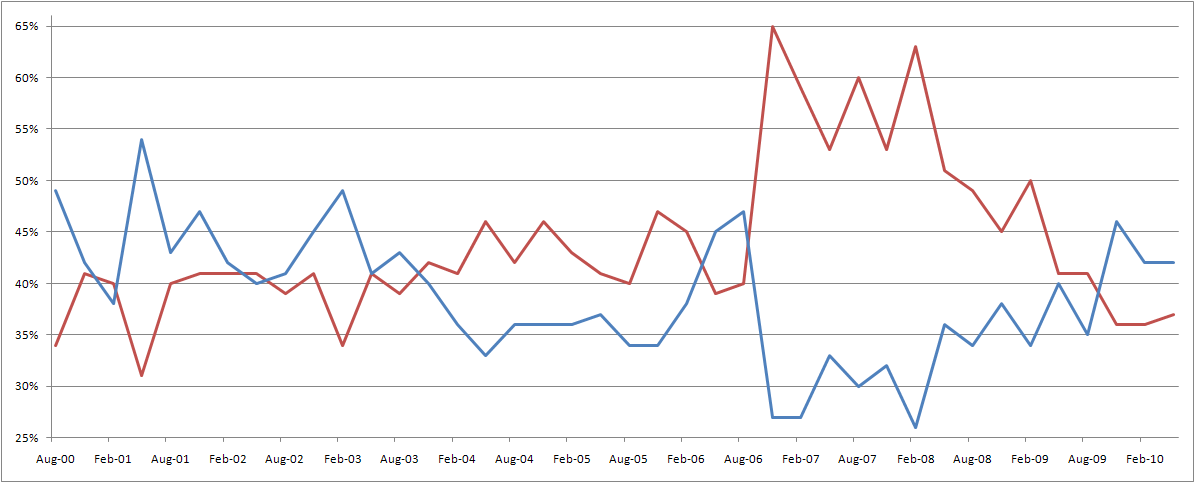
CRA is the only outfit that regularly polls New Brunswick politics. We can therefore look at trends over a long period of time. A friend was kind enough to send me a chart of all CRA quarterly polls going back 10 years.


As you can see, the honeymoon enjoyed by the Graham Liberals after the 2006 election was particularly sweet. Though we do not see back as far as Lord's first year in office, his second year compares unfavourably to Graham's. In order for the situation to normalize, the Liberals had to take a deep dive. However, they have likely dove too far for their liking.

Normally in a situation like this you might be able to make a guess on where things were going based on momentum. But for three polls in a row now, both parties are essentially stalled (Libs up 1, PCs down 4 with no movement in last poll). Both have reason to be optimistic. After jumping 11, then falling 4, the Tories have held their ground. The Libs after falling 5 have levelled out and started to tick back up.

But what we do see is that the polls are basically where they were on the eve of the last election (PC 45 - Lib 39).

So one of three things is going to happen. 1) Something dramatic and positive will happen in the short-term to change these numbers in someone's favour; 2) something dramatic and negative will happen during the writ to change the numbers against one's favour; 3) we'll see the same thing as in 2003 and 2006 where local campaigns and local candidates will be the deciding factors.

At this point, I lean towards #3 in my expectations.

Let the trench warfare begin.

He's back...

I bowed out of this a while ago, but with an election in the offing I won't be able to resist. Stay tuned for my commentary and predictions for New Brunswick's 2010 election.

Sunday, June 07, 2009

New Democrats to cruise to victory

If polls are to believed the NDP will have a convincing win on Tuesday night in Nova Scotia.

My previous post predicted the NDP would be on the cusp of a majority (winning 26 seats in the Nova Scotia House of Assembly gives you a majority if there is an opposition speaker and a minority with a government one) when the votes are counted.

Since there have been two new polls.

A CRA poll showed that in the last two weeks of May, the NDP surged substantially. Numbers from their early May poll and degree of change are in brackets:

NDP 44 (+7 from 37)
Lib 28 (-3 from 31)
PC 26 (-2 from 28)

An Angus Reid poll issued a few days later shows the NDP at an incredible 47, the Liberals at 26 and the PCs at 23.

If the NDP really are at 47%, things would be huge. If we were to assume the NDP was at 70% in the HRM, they would still be running at 35% everywhere else (higher than they ever have before). A more realistic number for the NDP would be 55% in the HRM (compared to 46.5% last time), which would give them nearly 43% in the rest of Nova Scotia.

Therefore, my revised prediction would be as follows:

NDP 36
Lib 10
PC 6

UPDATE:
So the final results were NDP 31, Lib 11, PC 10. Things actually turned out pretty well as I expected, except the Liberals did better in the HRM than I thought at the expense of the NDP and the PCs did better in Cape Breton than I thought at the expense of the Liberals.

Monday, May 25, 2009

The problem with wide appeal

I was in Nova Scotia last week and was starkly reminded that the only party with support all across the province is the Progressive Conservative Party.

In Cumberland County, you'd have to search a long time to find a Liberal sign. While in the western most parts of the Annapolis Valley, NDP signs were nowhere to be found.

The most recent poll showed the NDP at 37%, the Liberals at 31% and the PCs at 28%. If that PC support is spread relatively evenly across the province (the poll suggests it gets up to 35% in rural, mainland Nova Scotia) they could risk running second in virtually every riding in the province and get a share of seats that is far less than their numbers suggest. With Liberal support concentrated in the Valley/French Shore and Cape Breton, they're likely looking at a near sweep of those regions with 31%.

I am going to make the following seat prediction one weektwo weeks out:

NDP 26
Lib 17
PC 9

Whoops, I was originally thinking voting day was June 2, but it is actually June 9.

Tuesday, May 05, 2009

New Brunswick blogs and Nova Scotia votes

It is with some regret that I noticed today that the third of the three New Brunswick blogs I follow has stopped posting. Spink About It and now The Independent have both formally raised white flags, while Countering The Nanny State has been largely silent for months, with the last post early in the New Year.

I have never formally thrown in the towel and do plan to continue to post occasionally on non-political topics and on political topics I can't resist, as I have for the past while. One of those topics is elections, so expect a handful of posts over the next few weeks on the recently called Nova Scotia election.

This should be an interesting one. Barring a game-changer (certainly possible), I would almost certainly expect the NDP to win a plurality of seats. That doesn't make for a lack of excitement, however.

Does the NDP win the most seats, but not a majority? This seems most likely to me and, if so, who comes second? Logic suggests that the PCs should come second, but they only held their plurality last time thanks to favourite son Rodney MacDonald's unusually strong PC showing on Cape Breton Island. Should the Liberals hold their seats elsewhere and reclaim Cape Breton, they could come second.

Another issue is how big of a plurality will the NDP win, if at all? Their support is very heavily concentrated in the HRM, where they already hold virtually all of the seats. If their vote share continues to rise there, they'll get more and more popular votes but their seat total will remain steady. Where is their room to grow? They had some breakthroughs in rural Nova Scotia in 2006 - can they hold these and grow them? Will a likely lowering of PC support on Cape Breton break their way at all or is it all destined for the Liberals?

The other big question is, if the NDP doesn't win a majority, who will form a government? A lot of people misunderstand how our system works. Individual candidates are defeated in elections, not governments. Should the Tories win fewer seats than the NDP, they continue to be the government until they are defeated or resign. If the NDP wins a majority, by tradition the Tory government would resign. However, if the NDP wins a plurality but not a majority, the PCs would have the right to face the House and try to maintain confidence (as W.L.M. King did in 1925), something that could easily be successful either through a coalition government (done as recently as 1999 in Saskatchewan) or a confidence agreement (such as the one between the second and third party in Ontario in 1985) with the Liberals.

All of this makes for an interesting campaign, one I'll watch closely.

See also a post from a while back where I hypothesized the possibility of a Liberal government. The most recent opinion poll showed NDP 36, Lib 31, PC 30 - so anything could happen...

Saturday, March 28, 2009

Snob

How not to seem more in touch with the everyday Canadian:
Mimi, the Ignatieffs' four-month-old Burmese kitten. She recently moved into Stornoway after being personally escorted to Ottawa by Liberal MP Keith Martin, who represents the Vancouver Island riding where Mimi's breeder lives. It was an effort but Dr. Martin found a way - WestJet let him take the kitten on board with him - and delivered her to the Opposition Leader's official residence at 1 a.m. last Thursday.

A purebred kitten will cost you between $300 and $500, + vaccinations + spaying.

Meanwhile...
The Harpers also have cats but of less glamorous breeds - they foster cats through the Ottawa Humane Society's Foster Program.

Wednesday, February 18, 2009

More thoughts on PR

The Commission on Legislative Democracy recommended in 2005 that we move to a variety of proportional representation (PR) styled New Brunswick Mixed-Member Proportional (NB MMP). The system would have had 56 MLAs, 36 of which would be elected from traditional single-member first-past-the-post (FPTP) districts and 20, of which would be selected for 4 five-member districts using the additional member method (compared to 55 MLAs presently, all elected to single member ridings).

The multi-member district seats would not be selected based on the share of the votes the party received in those areas, but to compensate for the non-proportionality of the results therein. (Explained in the addtional member article linked above)

For example: Each region would have 9 ridings, each electing one member. Thereafter, the region would have 5 more members selected to represent the whole region. If Party A won 8 of 9 ridings with only 55% of the vote (i.e. they barely won each of eight, and barely lost one) and Party B had received only one seat on 45% of the vote, then Party B would receive all 5 of the regional members to compensate for having won only one traditional seat on 45% of the votes.

In order to presuppose the structure of the ridings, we'll have to overlay the existing 55 ridings into each of the regions suggested by the commission. That means 14 single member ridings will have to be transposed onto 3 of the regions and 13 will have to go into a final region. We'll place the Moncton-area districts into the 13 seat region, because those districts are the most overpopulated in the province.

The Commission recommended the following regions: North, Central, Southwest, Southeast. I will assign our current electoral districts to these regions as follows:
North
Grand Falls-Drummond-St. André, Restigouche-La-Vallée, Edmundston-Saint-Basile, Madawaska-Les-Lacs, Campbellton-Restigouche Centre, Dalhousie-Restigouche East, Nigadoo-Chaleur, Bathurst, Nepisiguit, Caraquet, Lamèque-Shippagan-Miscou, Centre-Péninsule-Saint-Sauveur, Tracadie-Sheila, Miramichi Bay-Neguac

Central
Victoria-Tobique, Carleton, Woodstock, York North, Fredericton-Nashwaaksis, Fredericton-Fort Nashwaak, Fredericton-Lincoln, Fredericton-Silverwood, New Maryland-Sunbury West, Oromocto, Grand Lake-Gagetown, Southwest Miramichi, Miramichi Centre, Miramichi-Bay du Vin

Southwest
York, Charlotte-Campobello, Charlotte-The Isles, Fundy-River Valley, Quispamsis, Rothesay, Saint John East, Saint John Harbour, Saint John Portland, Saint John Lancaster, Saint John-Fundy, Hampton-Kings, Kings East, Albert

Southeast
Petitcodiac, Dieppe Centre-Lewisville, Moncton East, Moncton West, Moncton North, Moncton Crescent, Riverview, Memramcook-Lakeville-Dieppe, Tantramar, Shediac-Cap-Pelé, Kent South, Kent, Rogersville-Kouchibouguac
A lot of these regions are less than ideal but this is the unfortunate result that can happen when you have to carve the province up into four equal-sized regions. Presumably when boundaries for ridings would have been redrawn, some would have been combined and others split in a fashion that would try to avoid this.

So now let's try to re-run the 2006 election under NB MMP. In each region, we'll take the actual results from 2006 in terms of seats, then scale that down to 9 ridings, then apply the NB MMP method to each set of regional seats.

2006 actual resultsProjected NB MMP seats
Seats% voteRidingRegionalTotal
PC2647.5161329
North545.0347
Central546.5347
Southwest746.6437
Southeast955.9628
Lib2947.120727
North948.7617
Central948.3617
Southwest747.0527
Southeast439.5336
NDP05.1000
North06.0000
Central05.2000
Southwest05.6000
Southeast04.7000

I am not sure if this is the result that PR proponets would have been looking for. The right-of-centre party, which won a bare plurality of votes (47.5%) would win a majority government, while left-of-centre parties who received 52.2% of the votes would be in the minority. The NDP, despite winning 5.1% of the vote would remain unrepresented in the legislature. The Liberals, despite winning a plurarilty of the vote in 3 of 4 regions, will have split the seats evenly in each of those regions, which seems somewhat unfair.

As I said in a comment to the last post on this, "the problem with the electoral reform debate in Canada (is that e)veryone seems to see it as black and white, when in fact there are countless models to choose from."

Using the model that was proposed by the Commission on Legislative Democracy would not have improved, in my view, the results of the last election. Regions with an odd number of members would likely have worked better, or perhaps the top up could have been done on a province-wide scale which would have allowed the NDP to get seats. Or we could have moved wholly to multi-member ridings (which our province used from pre-confederation to 1974 anyway) using the single transferable vote. Or we could have gone to countless other varieties of options.

As I said, that is the problem with the PR debate. When it is the status quo vs. the nearly infinite number of alternatives, change is quite popular. But when it is the status quo vs. one particular PR model, then these tend to fail (as votes in BC, Ontario and PEI have shown).

I suspect that most members of the NDP support PR in principle. I doubt many would favour the NB MMP model if they knew it would have meant they would still have been shut out of the legislature, and that a conservative government would have been re-elected with a larger majority in the last election.

This is why I've always prefered a gradual electoral reform. Canada was born out of evolution as opposed to revolution and it has served us well. We should do the same with any changes to our electoral system. A move from FPTP to a the preferential vote would be a relatively simple change that wouldn't turn our system on its head, and wouldn't confuse voters, but would answer many of the legitimate grievances of electoral reform proponents. Thereafter, if our objectives haven't been met, we could move further down the road.

Doesn't this seem more reasonable than totally replacing a system that, though imperfect, has served this country for well over a hundred years?

Tuesday, February 17, 2009

The drawbacks of proportional representation

Many Canadians have become frustrated, according to polls, with the fact that we had a federal election in 2004, 2006 and 2008 and could well have another in 2009 or 2010. At the same time, many have expressed dismay at the fact that the Green Party got 6.8% of the vote and won zero seats, while the Bloc Québécois got 10% of the vote and 16% of the seats.

Unfortunately, these two frustrations are largely incompatible. Though we might see the Greens win a seat or two with instant runoff voting (a model I support), it would not result in proportionality between votes and seats.

The reason we have had all of these elections is because of minority governments. With a system of proportional representation, the last time we would have seen a majority government at the federal level in Canada would have been 1984 when Brian Mulroney won 50.03% of the vote and before that 1958 when John Diefenbaker won 53.66%. Not even Pierre Trudeau's big sweep of 1968 won a majority of votes - he scored 45.37%.

The situation in Israel today is not dissimilar to that which we saw in Germany in 2005. The votes are spread so widely and the two "major" parties are so small and close to each other in size that the only option for government is a grand coalition of the major parties, which are forced to govern with a narrow set of objectives based on the few policy areas where those parties can agree to compromise.

This is no way to govern a country. We must have either majority governments, coalitions of like-minded parties or minority governments with a commitment from other parties to keep them in office for some time to have stable, effective government. If you ever think we could make all of our problems go away by bringing in PR, I would direct you to look at those countries who already "enjoy" that system of election. Based on the reaction of Canadians to the coalition proposal that came forward late last year, I would think that a system of PR would lead to a massive case of buyers remorse immediately following its first election.

Tuesday, January 06, 2009

130 teams on frozen pond

In a few weeks, Plaster Rock, New Brunswick will host players and fans from around the globe for the 8th annual World Pond Hockey Championships.

There will be 130 teams, representing 12 countries and four continents. It is quite an amazing feat for a small milltown struggling with the downturn in the forestry sector.
  • There are 76 teams from Canada, including 37 from New Brunswick.
  • There are 43 teams from the USA, including teams from as far away as Arizona, Oregon and Puerto Rico.
  • There are 6 teams from Europe and three from the Caribbean (including Puerto Rico).
  • Egypt's team represents Africa and Brazil represents South America.
Be there, or be square. February 19-22, 2009, featuring the Stanley Cup on the 19th.

For more information:
WPHC website
A great 2004 profile from the New York Times

Thursday, December 11, 2008

Senate appointments

Media reports suggest that the Prime Minister will be making the wise political move, and wise move for the functioning of the Senate, of filling the 18 vacancies that exist in that body. He will however have to battle a perception problem as he has vowed only to fill vacancies with elected Senators.

While still placing a large number of Conservatives in the Senate and filling all vacancies, there is a process where he would appear to respect his pledge to bring democracy to the Senate.

The 18 vacancies cover eight provinces and one territory. Harper could look to the results of the recent federal election in each of those jurisdictions for "advice" from Canadians on how to fill the Senate vacancies.

For instance, in Prince Edward Island, the Liberals hold 3 seats in the Senate and there is one vacancy. The Liberals received 47.7% of the vote and the Conservatives received 36.2%. If you break that out it says that Liberals should have 1.9 seats and the Conservatives 1.4. But because the Liberals already hold 3 seats, then the one vacancy should go to the Conservatives.

If you apply this across the 18 vacancies, the Conservatives would get 10, the NDP would get 7 and the Liberals would get 1.

In 2005, despite the fact that the NDP wants to abolish the Senate and refused to recognize the appointment, Paul Martin appointed a nominal New Democrat to the Senate. Harper could do something similar, appointing Canadians who could be deemed associated with the NDP who favour his Senate reform agenda.

Following this formula Newfoundland and Labrador would get an NDP senator, New Brunswick would get a Conservative and a New Democrat, Nova Scotia would get two New Democrats and a Conservative, PEI would get a Conservative, Quebec would get three Conservatives and a New Democrat, Ontario would get a Conservative and a New Democrat, Yukon would get a Liberal, Saskatchewan would get a Conservative, and British Columbia would get two Conservatives and a New Democrat.

The standings in the Senate would be:
Liberal 59
Conservative 30
NDP 8
PC 3
Ind 5

If the prime minister simply appoints 18 Tories, the standings would be:
Liberal 58
Conservative 38
PC 3
NDP 1
Ind 5

-- marginally better for the Tories but not worth the PR nightmare of going back on the pledge to appoint based on the will of Canadians.

Food for thought for my Conservative friends who may have the ear of the Prime Minister.

Wednesday, December 03, 2008

A dangerous precedent?

Martha Hall Findlay looks at the prorogation angle differently than I had ever considered.

If the governor general does allow a prorogation, would it be the end of responsible government in Canada?

The premise of responsible government is that the executive remains in office only so long as it enjoys the support of the responsible house of the legislature. If the governor general allows a prorogation and sets a precedent that a prime minister can seek and receive a prorogation anytime, even when it less than two weeks after a throne speech, with no legislation passed. This would allow any future prime minister to simply prorogue whenever a confidence vote they fear losing is scheduled.

This is a very interesting and fair point. One I'm surprised I've never heard mentioned by one of the countless "experts" who've been on TV the past week.

Monday, December 01, 2008

Coalition cabinet revised

So we've learned that it will be a cabinet of 25: the prime minister plus 24 ministers.

Thus, I'm revising my list, and also because I left out John McCallum who I think almost certainly would be in the cabinet.

Dion did not say whether or not leadership candidates would be in the cabinet, but I cannot imagine he would put them in. In order to be fair, they should all be given 'equal' portfolios, which is essentially impossible. Both Rae and Ignatieff would be logical choices for foreign minister, but that job is not an ideal one for running a leadership campaign. Finance minister is not a logical choice for either of them. The NDP is purported to be getting a major economic portfolio. Suddenly, there isn't much available for either Rae or Ignatieff and we've not even thought of LeBlanc. So I'd say it is easier for all if the leadership candidates focus on running for leader.

Finally, it is important to note that this coalition is not a done deal; the prime minister may yet request a prorogation (which the governor general may deny) or, if the government falls, an election (which she may grant).

All that in mind, my revised guess. An asterisk denotes a change from my earlier thoughts.

Prime Minister of Canada
Rt. Hon. Stéphane Dion

Minister of Agriculture and Agri-Food
Hon. Wayne Easter

Minister of Canadian Heritage
Hon. Marc Garneau

Minister of Citizenship and Immigration
Hon. Navdeep Bains

Minister of the Environment
Hon. Thomas Mulcair

Minister of Finance
Hon. Scott Brison

Minister of Fisheries and Oceans
Hon. Jack Harris

Minister of Foreign Affairs and Minister for International Cooperation
Hon. Ralph Goodale

Minister of Health
Hon. Ken Dryden

Minister of Human Resources and Social Development and Minister of Labour
Hon. Judy Wasylycia-Leis

Minister of Indian Affairs and Northern Development
Hon. Irwin Cotler

Minister of Industry
Rt. Hon. Jack Layton

Minister of International Trade
Hon. Gerard Kennedy

Minister of Justice
Hon. Ujjal Dosanjh*

Leader of the Government in the House of Commons
Hon. Libby Davies

Leader of the Government in the Senate
Hon. Claudette Tardiff

Minister of National Defence
Hon. John McCallum*

Minister of National Revenue
Hon. Bryon Wilfert

Minister of Natural Resources
Hon. Linda Duncan

Minister of Public Safety
Hon. Marlene Jennings

Minister of Public Works and Government Services
Hon. Mark Holland

Minister of Intergovernmental Affairs
Hon. Denis Coderre

Minister of Transport, Infrastructure and Communities
Hon. Martha Hall Findlay

President of the Treasury Board
Hon. David McGuinty

Minister of Veterans Affairs
Hon. Brian Murphy*

Coalition cabinet

I just can't resist a prediction.

Presuming that the government does fall, and the governor-general does call on Stéphane Dion to form a government, and that media reports indicating there will be eighteen Liberals and six New Democrats in the cabinet, and that the Finance Minister will be a Liberal are all correct, here is my prediction for the coalition cabinet:

Prime Minister of Canada
Rt. Hon. Stéphane Dion

Minister of Agriculture and Agri-Food
Hon. Wayne Easter

Minister of Canadian Heritage
Hon. Marc Garneau

Minister of Citizenship and Immigration
Hon. Navdeep Bains

Minister of the Environment
Hon. Thomas Mulcair

Minister of Finance
Hon. Scott Brison

Minister of Fisheries and Oceans
Hon. Jack Harris

Minister of Foreign Affairs and Minister for International Cooperation
Hon. Ralph Goodale

Minister of Health
Hon. Ken Dryden

Minister of Human Resources and Social Development and Minister of Labour
Hon. Judy Wasylyvia-Leis

Minister of Indian Affairs and Northern Development
Hon. Irwin Cotler

Minister of Industry
Rt. Hon. Jack Layton

Minister of International Trade
Hon. Gerard Kennedy

Minister of Justice
Hon. Brian Murphy

Leader of the Government in the House of Commons
Hon. Libby Davies

Leader of the Government in the Senate
Hon. Claudette Tardiff

Minister of National Defence and Minister of Veterans Affairs
Hon. Ujjal Dosanjh

Minister of National Revenue
Hon. Bryon Wilfert

Minister of Natural Resources
Hon. Linda Duncan

Minister of Public Safety
Hon. Marlene Jennings

Minister of Public Works and Government Services
Hon. Mark Holland

Minister of Intergovernmental Affairs
Hon. Denis Coderre

Minister of Transport, Infrastructure and Communities
Hon. Martha Hall Findlay

President of the Treasury Board
Hon. David McGuinty

Saturday, November 29, 2008

Coalition making

As a nerd who specializes his geekdom in areas of political history, I am very interested in the current matters of confidence and coalition in Ottawa.

First I must point out to my friends in the media that in their coverage, they've missed the most recent example of coalition in Canada - the NDP-Liberal coalition in Saskatchewan formed in 1999. Also, I'm surprised they've not referred to the long lasting Liberal-Conservative coalitions in BC from the 30s into the 50s or the Liberal-Progressive coalitions of Manitoba. There is lots of precedent for coalition in Canada at the provincial level. However, there is little precedent for the situation before us today.

The most analagous Canadian example is the King-Byng affair of 1926 but it is still not a very good example. In that case, the incumbent Liberals won less seats than the Conservatives in the 1925 election but neither had a majority, the second largest party - the Liberals - continued in office with the support of the third-party Progressives. When that government was on the verge of falling - it had not actually fallen - Prime Minister King went to the GG and asked for an election. The GG's correct response was that the government had not fallen, the election had been only 9 months earlier, and a larger single party was willing to form a government.

In the situation before us today, the party with the most seats would be defeated and a coalition of two parties who, even taken together, have considerably fewer seats, would propose to govern. That is quite a different situation. Moreover, Harper's last minority began with 124 seats and, in terms of share of seats in the commons, it was the smallest majority ever. The Liberal-NDP coalition minority would beat that record having only 114 seats or 37% of the total.

I've not researched it, but the only comparable example I can think of would be the 1975 dismisal of Prime Minister Gough Whitlam in Australia. In that case, Whitlam's budget had been defeated in the Senate and the opposition argued that that was an expression of non-confidence, while Whitlam said only the House could weigh in on a matter of confidence. Whitlam refused to resign or call for elections as, in his view, he enjoyed the confidence of parliament due to his support in the lower house. The GG disagreed, fired Whitlam and named the opposition leader as PM. As Whitlam had a majority in the lower house, the new PM's first act was to call for an election.
That doesnt quite map on to the situation before us, but it is the closest example I can think of.

Anyway, all that aside, due to the unprecedented proximity of the potential loss of confidence to the last election, the GG would likely have to give the Liberal-NDP coalition a shot despite its lack of historical precedent either for or against.

On to the make up of the coalition itself, I think that there is a fairly easy way to iron out a coalition agreement without getting bogged down in details.

There should be a cabinet of 30 - 20 of whom are Liberals, including the PM, and 10 of whom are New Democrats. Portfolios should be chosen by the parties in order with the NDP chosing the first portfolio and the Liberals picking the next two and continuing until the 29 non-prime ministerial posts are assigned.

An agreement should be made that ministers would enjoy their regular authority over matters of administration but that decisions of the cabinet would require a formal vote with a 2/3s majority in favour. This would prevent the need for policy matters to be totally hashed out in advance as the government would need some degree of consensus between the two partners going forward.

This sort of agreement would allow the parties to focus on their response to the economic situation, including measures that would allow for the Bloc to support the measure and subsequently the government on and on subsequent matters of confidence without having the agreement fall apart on the details.

Monday, November 24, 2008

Irony

From Canadian Press:
Paul Martin says Rae Ignatieff rivalry won't divide Liberal party

Former prime minister Paul Martin says he's confident the Liberal party will emerge united despite sparring between its two principal leadership hopefuls.

Martin, whose own acrimonious relationship with former prime minister Jean Chretien eventually drove him from his post as finance minister, says front-runners Michael Ignatieff and Bob Rae won't divide the party.

He says the Liberal party has learned its lesson and he's sure that once the new leader is chosen the party will be united.

Memories of past confrontations surfaced last week when Rae boycotted the party's closed-door, all-candidates' forum because chief rival Ignatieff wouldn't agree to lift the veil of secrecy.

That was the first public spat between candidates vying to replace Stephane Dion as leader after a disastrous defeat in last month's election.

It disappointed many in the party, who had hoped to avoid the kind of sniping that characterized the hard-fought campaign in which Dion came up the middle to win as a compromise candidate in the 2006 leadership race.

Neither Rae nor Ignatieff could take a clear majority last time around.

On Monday, Martin said all the candidates were ``outstanding'' but declined to endorse any one of them, saying he will remain a spectator.

New Brunswick's Dominic LeBlanc is also up for the party's top job.

Tuesday, November 11, 2008

Lest We Forget

I'll be heading out soon to a local Remembrance Day ceremony, I hope you're doing the same.

A few things to think about:
  • 28% of all eligible Canadians fought in World War I
  • 36% of all eligible Canadians fought in World War II
  • almost all of these were volunteers
  • would you put your life on the line to help our neighbour, let alone an idea, to survive?
  • would you like to live under a Nazi dictatorship?
To all those Canadians and other citizens of the world who risked or gave their lives in these and other wars, including the one they're fighting today, thank you.